Folk Computer: Programming Without the Rectangle
A hands-on look at Folk Computer, an open-source physical computing system that turns paper into executable programs, and the lineage of 'useless' research that made it possible.
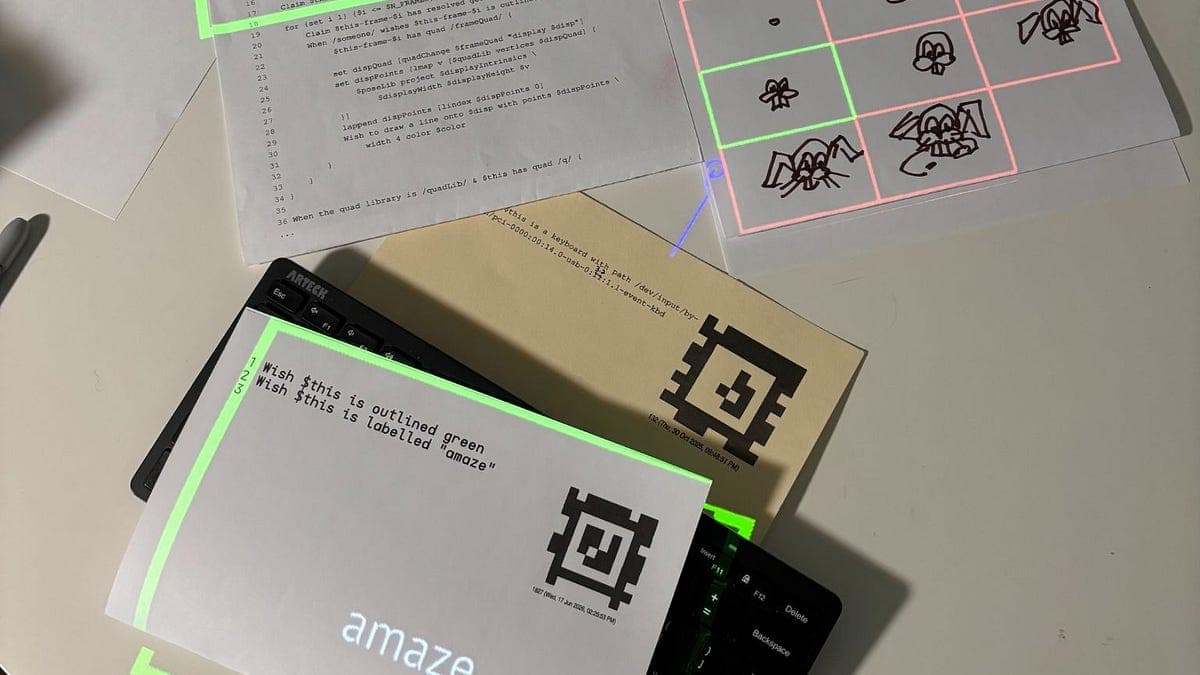
In a Brooklyn warehouse, a man handed me a piece of paper that was a running computer program. A printout would have been a picture of a program. This was the program itself. He set it on the table and the system executed it. Then he connected a keyboard to the paper, typed a line of code, hit save, and the paper turned green. He unplugged the keyboard and the paper kept running, glowing on the table like it had always known how.
This is Folk Computer, an open-source physical computing system built by Omar Rizwan and Andrés Cuervo, two researchers who worked at Dynamicland, Bret Victor's lab in Oakland. Cameras on the ceiling watch the room. Projectors paint onto every surface. Small tags identify each piece of paper, and each piece of paper is a program. There are no pixels inside the system; every coordinate is in meters, mapped to where things sit in the room. You stop staring into a rectangle. The computer is the room, and you program it together with other people, standing up, talking, drawing, moving paper around.
This is not a product. It is a research artifact from a lineage that runs back through Alan Kay's Xerox PARC, through Bret Victor's CDG lab (funded by SAP), through Dynamicland, and now into the open. The recurring criticism of this whole lineage is that you see the demos and cannot do anything with them. Folk Computer inverts that. The code is on GitHub. People around the world have set up their own systems. Strangers contribute. A friend of theirs built a music sequencer out of physical cards; flip a card, change a track.
The prototypes were built, in their own words, against usefulness. Usefulness, they had learned, is a trap: the moment a prototype becomes useful, its makers start answering to present users and stop pointing at the future. Paradigm work has always run on patrons. A new paradigm is useless at the beginning, by definition, so markets have nothing to price. The first personal computers were toys. So was the early internet. The people who fund this stage are buying a position in the future before anyone can price it.
Folk Computer is not about replacing your IDE. It is about asking whether the desktop metaphor, the screen, the cubicle, the solitary body hunched toward a rectangle, was a fifty year detour rather than a destination. For the first time I was programming with my whole body, collaborating with another person in the same room, with almost no distance between the idea and the thing. It was the most human programming I have ever done.
Discussion
0 Comments
Be the first to start the discussion.