Java 26 Ships 10 JEPs: Tighter Pattern Matching, Final Field Enforcement, and Lazy Constants
JDK 26 lands on March 17, 2026 with 10 JEPs including a fourth preview of primitive pattern matching, a warning for reflective final-field mutation, and a renamed Lazy Constants API.
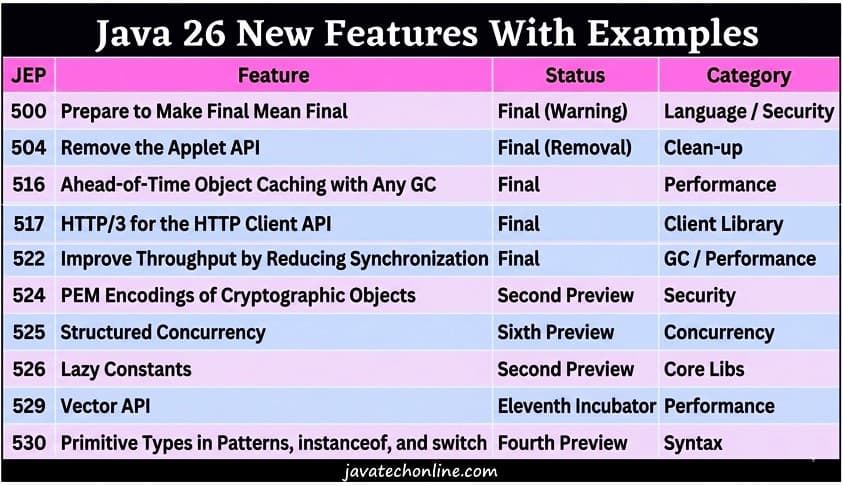
Java 26 dropped on March 17, 2026 — a non-LTS release that packs 10 JEPs into language semantics, security hardening, and runtime improvements. Oracle will support it for six months before nudging everyone to Java 27. Here's what matters.
Primitive Types in Patterns: Fourth Preview Gets Stricter
JEP 530 continues the long-running effort to let pattern matching work directly with primitives. This fourth preview tightens two things: unconditional exactness for safer type conversions, and dominance checks in switch that now catch unreachable cases at compile time.
The practical upside: you can write switch over an Object with primitive patterns without boxing, and guard ranges directly:
Object price = 250;
switch (price) {
    case int p when p < 100  -> System.out.println("BUDGET: " + p);
    case int p when p < 500  -> System.out.println("MID: " + p);
    case int p               -> System.out.println("PREMIUM: " + p);
    case double d            -> System.out.println("Double price: " + d);
    default                  -> System.out.println("Unknown type");
}
The compiler now rejects code like this, which compiled silently in Java 25:
int i1 = 100;
switch (i1) {
    case float f   -> {}   // ERROR: constant below is dominated
    case 16_777_216 -> {}  // unreachable — float can represent this value exactly
    default        -> {}
}
If your codebase uses pattern matching heavily, expect a few new compilation errors after upgrading.
JEP 500: Making Final Actually Final
Deep reflection has let libraries bypass final fields for years. Java 26 starts closing that loophole. By default, reflective mutation of a final field now prints a warning:
WARNING: Final field value in class Box has been mutated reflectively
WARNING: Use --enable-final-field-mutation=ALL-UNNAMED to avoid a warning
WARNING: Mutating final fields will be blocked in a future release
You can control the behavior with --illegal-final-field-mutation set to warn (default), allow, or deny. The plan is to make deny the default in a future release. If you use frameworks that rely on reflective field mutation (some serialization, ORM, or injection libraries), test now and fix upstream or suppress the warning.
JEP 526: Lazy Constants (Second Preview)
Renamed from “Stable Values” (JEP 502 in Java 25), Lazy Constants let you define objects whose value is computed lazily but then treated as a true constant by the JVM — enabling optimizations like constant folding. The API has been simplified; expect a LazyConstant factory that returns an immutable holder. This is still preview, so you need --enable-preview to play with it.
Other JEPs Worth Mentioning
The remaining JEPs cover library and security improvements: updates to the KeyStore API, a new Vector incubator module, and cleanup of deprecated SecurityManager code. None are headline-grabbers, but they reduce friction for teams maintaining modern Java stacks.
Bottom Line
Java 26 is a solid short-term release. The pattern matching tightening and final-field enforcement are the two changes most likely to break existing code — in a good way. Upgrade your CI pipeline, scan for warnings, and plan for the LTS jump to Java 27 later this year.
Source: JavaTechOnline
Discussion
0 Comments
Be the first to start the discussion.