Robot Hand-Writes Scripts It Never Trained On—By Learning Stroke Structure
Brown University researchers trained a robot to hand-write Japanese characters, then watched it generalize to Hindi, Greek, English, and even a Mona Lisa sketch—without retraining. The key: separating local stroke control from global pen movement.
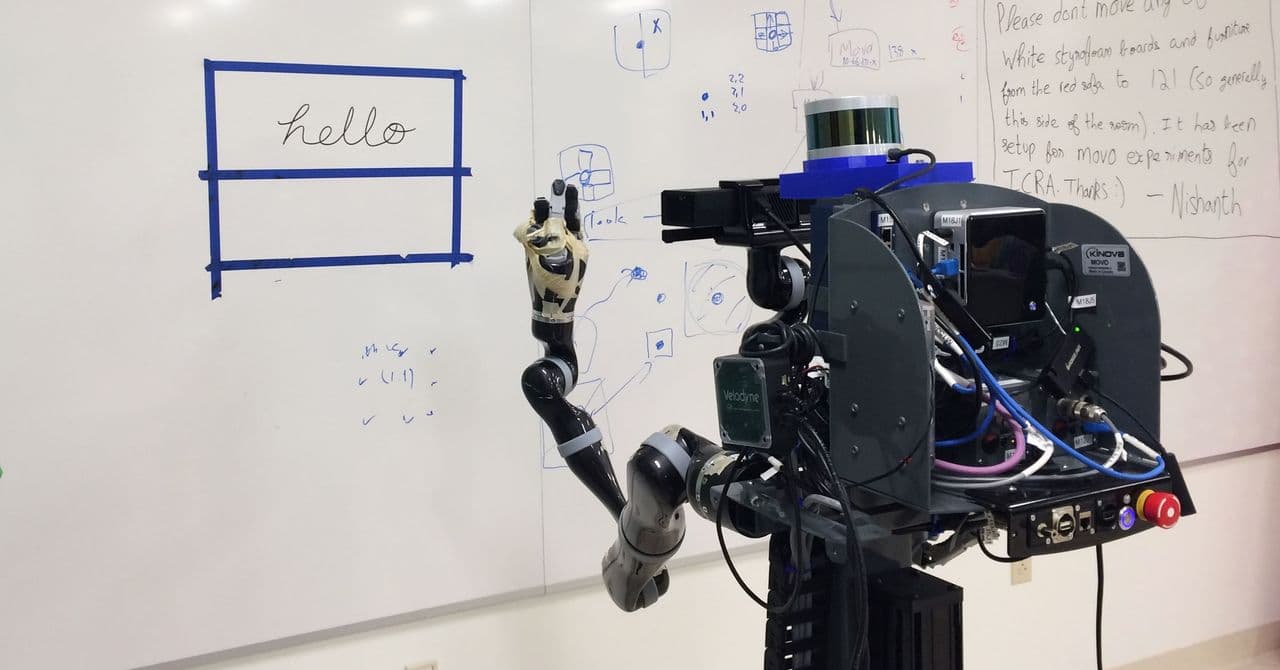
Handwriting is one of those human skills that looks trivial until you try to automate it. A robot that can write a word has to decide where to place the pen, how long to draw each line, when to lift the pen mid-letter (like the crossbar on a capital A), and where to put it back down. Most robotic writing systems sidestep this by treating each character as a fixed template. Researchers at Brown University took a different route: they trained a robot to learn the structure of strokes, not just the pixels.
The system, developed by roboticist Stefanie Tellex and PhD student Atsunobu Kotani, splits the task into two models. A local model handles the current stroke—aiming the pen and deciding when to end the stroke. A global model moves the pen to the start of the next stroke. The robot was trained on a corpus of Japanese characters, with annotations about how each character's component strokes fit together. From that, it learned to look at an image and predict where to start the next stroke and how to move while drawing to reproduce the target.
The surprising result came when the researchers tested generalization. They wrote words on a whiteboard in Hindi, Tamil, and Yiddish—scripts the robot had never seen—and it copied them correctly. It also handled English print and cursive, despite having only trained on Japanese. Even a rough sketch of the Mona Lisa was replicated.
The system isn't perfect. Because modern Japanese is written left-to-right, the robot generalized well to other left-to-right scripts, but struggled with right-to-left languages like Arabic or Hebrew. That's a clue that the model isn't learning universal writing rules—it's learning a directional bias from its training data.
This is a step toward robots that can communicate with humans in a more natural way—leaving handwritten notes instead of spitting out thermal printouts. But it also highlights a deeper point about generalization in machine learning: when a model learns the right abstractions (stroke structure), it can transfer to novel inputs; when it learns superficial patterns (text direction), it fails.
They give you these little algorithms for what strokes to do and what order to put them in to make the character. And that's what our algorithm is learning to do.
Source: WIRED
Discussion
0 Comments
Be the first to start the discussion.