The Great Blogging Collapse: 85% Traffic Loss and What It Means for Content Engineering
A cohort study of 100 once-celebrated blogs reveals a median 85% drop in organic search traffic between 2022 and 2026. Only 21 survived and grew. The lesson for engineers: don't build on rented land.
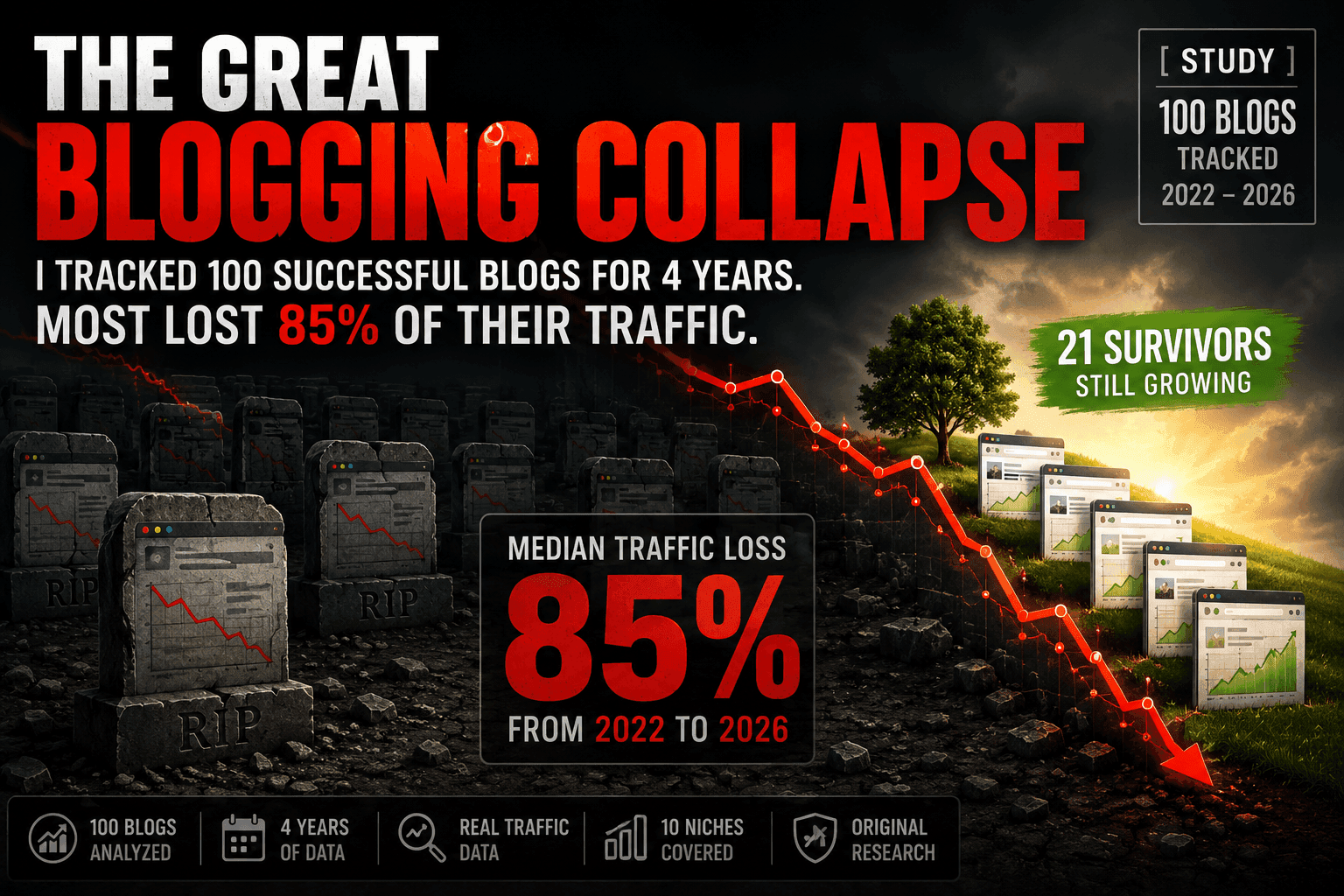
For over a decade, the playbook for making money online was simple: publish helpful content, rank on Google, monetize with ads and affiliate links. That era is over. A new study tracking 100 blogs that were once held up as proof of the model shows a median loss of 85% of organic search traffic between 2022 and 2026. More than half suffered catastrophic declines. Only 21 blogs are still growing.
The Study Design
The author selected 100 blogs that appeared in “six-figure blogger” roundups in 2022, then measured their total and organic search traffic using Semrush estimates for April 2022 and April 2026. The cohort covers 10 niches: blogging, food, finance, DIY, travel, tech, parenting, lifestyle, health, and other. Key metrics included traffic deltas, SEO share, monetization methods, and impact from Google's Helpful Content Update (HCU).
The Carnage in Numbers
- Median traffic loss: 85%. The typical blog now runs on about one-seventh of its 2022 traffic.
- 55 out of 100 blogs were gutted, wiped out, or dead.
- 20 blogs lost 99% or more of their traffic; 12 are at zero organic visits.
- Total monthly traffic across all 100 fell from ~17.8M to ~12M, but that average is misleading: three food sites (Kitchen Sanctuary, Pinch of Yum, Jessica Gavin) grew so much they mask the collapse. Excluding them, the other 97 dropped 63%—from ~11M to ~4M monthly visits.
Why It Happened
Google added “Experience” to its E-E-A-T framework in December 2022, then rolled out the Helpful Content Update in September 2023, which devastated independent publishers. The March 2024 core update explicitly aimed to cut low-quality content by ~45%. AI Overviews became default across 2025–2026. These blogs were built on informational queries (“how to”, “best ways to”) that AI can summarize without a click. Their traffic came almost entirely from Google organic—no owned audience, no diversification.
What the Survivors Have in Common
The 21 growing blogs share traits that matter for anyone building content-driven products:
- Experience that can't be AI-summarized: recipes, DIY projects, travel experiences—content that requires firsthand knowledge.
- Brand and direct traffic: they built audiences that type the URL or search by name, not just generic queries.
- Multi-channel distribution: newsletters, YouTube, social—Google is one acquisition channel, not the business itself.
Engineering Takeaways
This isn't just a blogging story. It's a cautionary tale for any product that depends on a single distribution channel controlled by a third party. Whether you're building a SaaS, a developer tool, or a content site, the lesson is the same: own your audience, diversify your acquisition, and create value that can't be commoditized by an AI summary. The era of building solely for Google traffic is over.
Discussion
0 Comments
Be the first to start the discussion.