The Silent Convergence: Why Go, Rust, and Kotlin Are Headed in the Same Direction — And Why It Matters

An Indescribable Feeling
There is a very specific moment that any developer — after years of living with Java or C# — experiences when they first get their hands on Rust or Kotlin: a feeling of weightlessness.
It’s not "weightless" in the sense that the language is easy to learn. It’s weightless like a room that has just been decluttered. Lines of code are no longer dense with keywords. Data types don't have to be repeated twice. The public static final of yesteryear — gone. Long, winding getters and setters — gone. Even the stubborn semicolons have… vanished.
I remember the first time I wrote a Rust function to replace a similar task in legacy Java; I kept feeling like I had forgotten something. Is it really this short? Is this actually correct? And yes, it was. The code ran. The compiler didn't complain.
But that "light" feeling is neither a stroke of luck nor a passing trend. It is the result of a nearly fifty-year paradigm shift in computer science regarding who should shoulder the hard part: humans, or the machine?
In this article, I want to dive deep with you into the four pillars that forged this syntactic revolution. More importantly — why this isn’t just a debate about "beautiful" versus "ugly" code, but a story about programming philosophy in the 21st century.
A Little History: Why Legacy Syntax Felt So "Heavy"
Before we reflexively bash Java, C, and C# as developers often do, let’s ask a fair question: why were they designed that way in the first place?
The answer lies in the hardware constraints and compiler capabilities of the eras in which they were born:
C (1972) emerged on PDP-11 machines with only a few dozen kilobytes of RAM. Every single byte was precious. Compilers had to be simple enough to act almost as a direct translator from keywords to assembly. You had to spell everything out — because the compiler didn't have enough "breathing room" to think for you. The concept of type inference back then lived only in academic papers, nowhere near production.
Java (1995) was born to solve the "write once, run anywhere" problem in the early days of the Internet. James Gosling’s philosophy was to make code explicit, readable, and safe. Mandating explicit type declarations was a deliberate choice — so that Java code could be read and maintained by hundreds of people across massive enterprise teams.
C# (2000) was Microsoft’s response to Java, inheriting much of the "explicit is better" philosophy but with a more pragmatic edge — and later on, moving much faster than Java in adopting modern features.
These languages weren't "wrong" — they were right for their time. What we look at today as "boilerplate" was viewed twenty-five years ago as "natural, built-in documentation." When you read public static final String CONFIG_KEY, you knew exactly everything about that variable without looking anywhere else.
But times have changed.
Compilers are thousands of times smarter. Hardware is so cheap that saving a few CPU cycles is often negligible. And most importantly: developer time has become the most expensive resource for modern software companies.
That shift is the foundation upon which the following four pillars were built.
Pillar 1: Type Inference — When the Compiler Is Smart Enough to Guess
This is perhaps the most immediately noticeable difference between the two generations.
The Problem: Redundancy to the Point of Meaninglessness
Look at this classic Java declaration prior to Java 7:
Map<String, List<User>> registry = new HashMap<String, List<User>>();This single line states the exact same information three times: in the declaration, in the constructor, and (indirectly) in the generic type. You — the human — knew what type registry was the moment you wrote the right-hand side. The compiler could infer it too. So why did we have to say it all over again?
The answer: because early compilers weren't smart enough. But today, they are.
Evolution Over the Decades
// Java 6 (2006) - The peak era of boilerplate
Map<String, List<User>> registry = new HashMap<String, List<User>>();

// Java 7 (2011) - The diamond operator cuts the pain in half
Map<String, List<User>> registry = new HashMap<>();

// Java 10+ (2018) - 'var' arrives after nearly a decade
var registry = new HashMap<String, List<User>>();// Go - The := operator handles declaration and inference all at once
registry := make(map[string][]User)// Kotlin - val/var explicitly distinguishes immutability
val registry = hashMapOf<String, List<User>>()// Rust - Often requires no type declaration whatsoever
let mut registry = HashMap::new();
registry.insert("alice".to_string(), vec![user1]);
// Rust looks down at the next line and infers backward: HashMap<String, Vec<User>>Every single one of these blocks achieves the exact same thing. The difference lies entirely in who writes the data type: the developer, or the compiler.
A Technical Nuance Often Overlooked: Not All Type Inference Is Created Equal
Rust uses a variant of Hindley-Milner type inference — an algorithm originating from ML and Haskell that is capable of backward inference (deducing the type of a variable based on how it is used in subsequent lines).
Go uses a much simpler local type inference — it only infers from right to left, with no backward reasoning. That is why Go's
:=operator only works when the right-hand side already provides sufficient information.Kotlin stands in the middle: more powerful than Go, but it doesn't go as far as Rust in inferring across multiple steps.
The smarter the compiler, the shorter your code can be — but the trade-off is that when things go wrong, the error messages become significantly harder to decipher. This is a conscious design choice.
val vs var — A Story Beyond Mere Syntax
A crucial detail that beginners often miss is immutability.
valin Kotlin = "assign-once binding" (akin to Java'sfinalorconstin other languages).varin Kotlin = "reassignable binding".letin Rust is immutable by default — you must explicitly writelet mutto allow reassignment.
This isn't just cosmetic. Modern languages push immutability as the default because decades of software engineering have taught us a bitter lesson: freely mutable state is the root cause of the most baffling bugs, especially in multithreaded environments.
Pillar 2: Expression-Oriented — Code as a Complete Sentence
This shift runs deeper and is less obvious than type inference, but it completely reshapes how you think when writing code.
Statement vs Expression: The Fundamental Difference
Statement: A command that tells the computer to "do something." It does not return a value. For example:
if (x > 0) { doSomething(); }in Java.Expression: Something that can be evaluated to produce a value. For example:
2 + 3yields5. Orx > 0yieldstrue/false.
Traditional C, Java, and C# are statement-oriented: blocks like if, try, and for are statements that return no value. If you want to capture a value out of them, you must declare a temporary mutable variable or resort to the ternary operator ? :.
Conversely, Rust and Kotlin (and to an extent, Scala and F#) are expression-oriented: nearly everything is an expression that yields a value.
Direct Comparison
Let's take a simple scenario: assigning a string status based on a health value.
Traditional Java — requires a temporary, mutable variable:
Java
String status;
if (health > 50) {
    status = "Healthy";
} else if (health > 20) {
    status = "Warning";
} else {
    status = "Critical";
}
Or using the ternary operator — which rapidly becomes unreadable when nested:
String status = health > 50 ? "Healthy"
              : health > 20 ? "Warning"
              : "Critical";
Kotlin — when is an expression:
val status = when {
    health > 50 -> "Healthy"
    health > 20 -> "Warning"
    else        -> "Critical"
}
Rust — match is an expression, and the last expression of a block without a trailing semicolon ; is implicitly returned:
let status = match health {
    h if h > 50 => "Healthy",
    h if h > 20 => "Warning",
    _           => "Critical",
};
The most elegant part of Rust is that this rule — "the final expression without a semicolon is the return value" — applies to function bodies as well. You don't even need the return keyword:
fn double(x: i32) -> i32 {
    x * 2  // No semicolon — this is the return value
}
Why This Matters
Being expression-oriented isn't just about "writing fewer lines." It changes your cognitive flow:
Less mutable state: When an
ifblock returns a value, you no longer need to declare a mutablevar statusand constantly reassign it. By default, you stick to immutableval/let. The code is cleaner, easier to reason about, and inherently thread-safe.Code reads like natural language: "The status is one of these values" — rather than "I will create a variable, and depending on conditions, I will modify it down the line."
Fewer opportunities for bugs: If you miss a branch in an
ifexpression, the compiler flags it immediately because an expression must evaluate to a value. In Java, you might accidentally forget to assign a value in one of the branches; the variable still exists in scope, but it remains uninitialized or invalid.
This is a mindset borrowed from Functional Programming (Haskell, Lisp, ML) — a stream of thought that incubated in academia for decades before mainstream languages finally paid attention.
Pillar 3: Safety by Default — Moving Errors from Runtime to Compile-Time
This is the philosophical core of the story. And it also happens to have the greatest economic impact.
The War on Null: The Billion-Dollar Mistake
In 2009, Tony Hoare — the inventor of the null reference in 1965 — publicly called it his "billion-dollar mistake." It is estimated that bugs tied to NullPointerException have caused billions of dollars in losses for the global software industry, ranging from mobile app crashes to severe security vulnerabilities.
In classic Java, C#, and C++, every reference can potentially be null. As a result, you have to write defensive code everywhere:
if (user != null) {
    Address address = user.getAddress();
    if (address != null) {
        String street = address.getStreet();
        if (street != null) {
            // ... finally do something with street
        }
    }
}
This is the "staircase of doom" — a descent into indentation hell that every Java developer knows all too well.
The New Generation's Solution: Encoding Nullability into the Type System
Kotlin integrates nullability directly into its types. By default, variables cannot be null:
val name: String = "Dai"        // Can never be null — guaranteed by the compiler
val nick: String? = null         // Explicitly nullable — must be handled before use

// When using a nullable type, the compiler forces you to handle it:
val length = nick?.length ?: 0   // Safe call + elvis operator
Rust goes a step further — it eliminates the concept of null entirely. Instead, it uses the Option<T> enum:
let name: String = String::from("Dai");
let nick: Option<String> = None;

// You are forced to pattern match to extract the value:
match nick {
    Some(n) => println!("Nick: {}", n),
    None    => println!("No nickname found"),
}
Null hasn't vanished; rather, it has been formalized into the type system, forcing the compiler to check every edge case at compile-time. You will no longer find yourself debugging a NullPointerException at 3 AM.
Memory Management: Three Philosophies, Three Paths
How a language cleans up memory shapes its entire syntax. Let’s look at the three primary paths:
1. Manual Management (C, C++)
char* buffer = malloc(1024);
// ... use buffer ...
free(buffer);
Forget this line? Memory leak.
Call it twice? Undefined behavior.
Use it after freeing? Use-after-free → a severe security vulnerability.
Absolute freedom, absolute responsibility. The majority of catastrophic security exploits in history (Heartbleed, EternalBlue, endless browser CVEs) stem from memory bugs in C/C++. Microsoft once revealed that roughly 70% of the security vulnerabilities patched in their products were memory safety issues.
2. Garbage Collection (Java, C#, Go)
String[] buffer = new String[1024];
// ... use buffer ...
// No need to free — the GC cleans it up when it's no longer referenced
Simple for the developer. However, the background Garbage Collector introduces unpredictable pauses — a major pain point for real-time systems, game engines, and low-latency trading platforms.
Go's GC is optimized for ultra-short, sub-millisecond pauses at the expense of lower overall throughput, making it ideal for network services. Java offers a vast landscape of GCs to choose from (G1, ZGC, Shenandoah) depending on your workload, with ZGC achieving pauses under 1ms even on multi-terabyte heaps.
3. Ownership (Rust) — The Third Path
let buffer = String::from("hello");
// ... use buffer ...
// Out of scope → Rust automatically calls the destructor. No GC, no pauses.
Rust’s philosophy states that every value has a single "owner" at any given moment. When the owner goes out of scope, the memory is automatically freed — a fact determined entirely at compile-time. There is zero runtime overhead.
This represents a massive paradigm shift. Rust's syntax for references (&, &mut) and lifetime annotations ('a) may look daunting initially, but they are encoding information that other languages either ignore or handle at runtime:
fn longest<'a>(x: &'a str, y: &'a str) -> &'a str {
    if x.len() > y.len() { x } else { y }
}
The 'a syntax here states: "the returned reference will live at least as long as the shorter lifetime of the two inputs." The compiler uses this contract to guarantee that you can never end up with a dangling pointer.
It demands a steep syntactic tax upfront. But in return, you get no GC, no runtime overhead, and no memory bugs — a combination previously deemed impossible. Rust is the first language in mainstream history to prove that you don't have to choose between performance and safety.
Pillar 4: Cutting Out the Noise
The final pillar might seem superficial, but it is the one you interact with most frequently throughout your day.
The Semicolon ;
Go, Kotlin, Swift, and Python have either removed or made semicolons entirely optional. Modern lexers and parsers are smart enough to deduce where a statement ends without needing an explicit marker.
An interesting trivia: Go actually uses semicolons internally, but the compiler automatically injects them via a mechanism called automatic semicolon insertion. You write code without semicolons, the compiler adds them behind the scenes, and 99% of the time, you never have to think about it.
Parentheses () Around Conditions
// Java
if (x > 0 && y < 10) { /* ... */ }
// Go, Rust
if x > 0 && y < 10 { /* ... */ }
It’s a minor detail. But multiplied by the millions of if statements you will write in your career, it adds up.
Encapsulation: From Thousands of Lines of Getters/Setters to Minimalism
Classic Java forces you to write:
public class User {
    private String name;
    private int age;

    public String getName() { return name; }
    public void setName(String name) { this.name = name; }
    public int getAge() { return age; }
    public void setAge(int age) { this.age = age; }

    @Override public boolean equals(Object o) { /* 10 lines of code */ }
    @Override public int hashCode() { /* 5 lines of code */ }
    @Override public String toString() { /* 3 lines of code */ }
}
That is over 30 lines of code just to hold two fields of data. Project Lombok emerged as a saving grace, but it remains a band-aid — requiring an extra dependency, IDE plugins, and an annotation processor.
Modern languages address this at the root level:
Kotlin offers data class:
data class User(val name: String, val age: Int)
// Automatically generates equals(), hashCode(), toString(), copy(), and componentN()
Rust utilizes structs and derive macros:
#[derive(Debug, Clone, PartialEq)]
struct User {
    name: String,
    age: u32,
}
Go takes it to an extreme — visibility is determined solely by casing:
type User struct {
    Name string  // Public (Capitalized)
    age  int     // Private (Lowercase)
}
No public or private keywords. No default getters and setters. It is aggressively simple, forcing developers to rely on clean conventions.
To be fair, Java 14+ eventually fired back with record:
public record User(String name, int age) {}
This is a clear victory of modern philosophies influencing legacy design — which brings us to our next point.
The Antithesis: The "Old Guard" Isn't Standing Still
This is a perspective that many articles glorifying "modern languages" tend to leave out. Java, C#, and C++ are not stagnant; they are aggressively learning from the new generation.
In the past 5 to 7 years, Java has introduced a wave of features borrowed from modern ecosystems:
var(Java 10, 2018) — Local type inference.Switch expressions (Java 14, 2020) — Turning
switchinto an expression, similar to Rust.Text blocks (Java 15) — Clean, multi-line string literals.
record(Java 16, 2021) — Immutable data classes inspired by Kotlin.Pattern matching for
instanceof(Java 16) andswitch(Java 21).Sealed classes (Java 17) — Restricting class hierarchies, much like Rust enums.
Virtual threads (Java 21, 2023) — A concurrency model heavily inspired by Go's goroutines.
C# has actually moved even faster than Java for years, taking a more pragmatic approach to adopting features:
var(C# 3.0, 2007) — Preceding Java by a decade.Nullable reference types (C# 8, 2019) — Adopted directly from Kotlin.
Records (C# 9, 2020) — Arriving ahead of Java.
Extensive pattern matching additions across multiple recent versions.
C++ has evolved as well, incorporating auto, structured bindings, concepts (similar to Rust traits/Haskell typeclasses), std::optional, and smart pointers (unique_ptr, shared_ptr) as a form of "ownership lite."
So Why Not Just Stick with Modern Java or Modern C#?
It's a completely valid question. The answer comes down to one thing: legacy is a double-edged sword.
Java added var, but it must still remain backward compatible with 30 years of legacy code. You can still run into a NullPointerException. You still have to live with the GC. You end up with both "old Java" and "new Java" coexisting in the same codebase, which can muddy coding styles and confuse developers reading legacy systems.
Languages like Rust were designed from a blank slate around these modern principles. They carry no historical baggage. That is an incredible advantage — but it's also their greatest hurdle (a smaller ecosystem, fewer libraries, a scarcer talent pool, and tougher hiring).
This isn't a winner-take-all battle. It's the diversification of an ecosystem, and that is a net positive for the entire industry.
The Trade-Off: There Is No Silver Bullet
I don't want this piece to read like a one-sided praise song for new languages. Every syntactic choice comes with a trade-off — and recognizing this is the hallmark of a mature developer.
Overly powerful type inference can lead to cryptic error messages. When a compiler infers types across dozens of steps and hits a contradiction, error messages in Rust or Scala can span dozens of lines, packed with abstract terminology, requiring deep expertise to untangle. It can be incredibly daunting for newcomers.
Expression-oriented design can make debugging harder for beginners. When everything is a nested expression, you lose the natural "stopping points" where you would typically drop a print statement or a breakpoint in traditional statement-oriented code.
Rust's Ownership model features a notoriously steep learning curve. The borrow checker is famous for a reason — plenty of developers walk away from Rust after a few weeks, exhausted from "fighting the borrow checker." Development velocity for quick prototyping remains a genuine weakness for Rust.
Go's minimalist syntax can morph into verbosity as a project grows large. For a long time, Go lacked robust generics (which finally arrived with limitations in Go 1.18). There’s a well-known adage in the community: "Go is a minimalist language for small projects, but the most verbose language for massive ones." The endless repetition of
if err != nilhas become an immortal meme.Kotlin's null safety can still be compromised when interacting with legacy Java code through what the compiler calls "platform types" — types where the compiler cannot definitively verify nullability.
The Right Tool for the Job
Each language represents a deliberate set of trade-offs engineered for a specific class of problems:
Language | Primary Use Case | Upside | Downside |
Go | Network services, microservices, CLI tools | Rapid learning curve, high readability | Can feel overly verbose at scale |
Rust | Systems software, embedded, low-latency, blockchain | Absolute correctness, peak performance | Slow initial development velocity |
Kotlin | Android development, JVM backend architecture | Pragmatic enterprise utility, seamless Java interop | Academic compromises for compatibility |
Java / C# | Large enterprise software, massive teams, legacy systems | Elite tooling, massive ecosystem, stability | Trapped with legacy language design |
C / C++ | Kernels, drivers, game engines, low-level systems | Total hardware control | High risk of critical memory bugs |
There is no "best language." There is only the most appropriate language for the specific problem you are trying to solve.
Conclusion: Syntax Is Philosophy, Not Just Keystrokes
This has been a long read, and I appreciate you sticking with me to the end. Because what I really wanted to share isn't that "Rust is better than Java" — that is a tedious, ego-driven debate that asks the wrong questions.
What I wanted to convey is that every single syntactic choice in a language is an answer to a deeper philosophical question about what programming ought to be.
When C forces you to write
mallocandfree, it’s saying: "The computer is a machine, and you must understand it the way a mechanic understands an engine."When Java introduced the Garbage Collector, it said: "No, the computer should serve the human — let the runtime handle the heavy lifting."
When Rust engineered ownership, it said: "There is a third path — push the difficult decisions to compile-time, so the runtime can remain silent and fast."
When Kotlin added
?for nullable types, it said: "A billion-dollar mistake shouldn't be accepted as a fact of life — let’s bake it directly into the type system."When Go withheld generics for 13 years only to add them with immense caution, it said: "Simplicity isn't easy — it requires a discipline that is harder than we think."
The silent convergence of Go, Rust, and Kotlin around a shared core of values — type inference, expression-oriented workflows, safety-by-default, and syntactic minimalism — is no accident. It represents the maturation of our industry after half a century of empirical experience. It is the collective synthesis of countless sleepless nights spent chasing a NullPointerException, countless security breaches caused by a buffer overflow, and countless hours wasted writing repetitive getters and setters.
As developers working today, we are incredibly fortunate to live in an era with such a rich palette of choices. Shifting your mental model from Java's statement-oriented world to the expression-oriented paradigm of Kotlin and Rust, from managing runtime execution to mastering compile-time guarantees, is a profound journey. It’s challenging at first. Then it becomes second nature. And eventually, you realize you can't go back.
I am not suggesting you abandon Java or C# — they remain phenomenal tools that evolve substantially every year, and there are many environments where they remain the absolute best choice. But if you haven't given Rust, Go, or Kotlin a serious try yet — meaning spending a month building an actual, non-trivial project, not just a "Hello World" — I highly encourage you to do so. Not to chase a trend or upgrade your resume, but to expand the very horizon of how you conceptualize code.
Because ultimately, the languages we write in every day shape the way we think. Ludwig Wittgenstein famously remarked about natural languages: "The limits of my language mean the limits of my world." That statement holds true — perhaps even more so — for programming languages.
Choosing a great language is about granting yourself a wider world to think in.
💬 What's Your Story?
I’d love to hear your thoughts in the comments below:
What language do you find yourself using for your daily work, and what led you to it?
Was there a specific "aha!" moment — after moving from an older language to a newer one — where you realized you could never look back?
Or conversely, is there a specific feature from an "older" language that you genuinely miss when working in modern environments?
Related reading

Where Does Real Knowledge Come From in the Age of AI?
AI answers everything with the same confident tone, whether right or wrong. The only way to catch its errors is to already know the domain. This essay maps six knowledge sources—books, primary documents, vetted updates, courses, people, and practice—and argues that cross-referencing them is the…
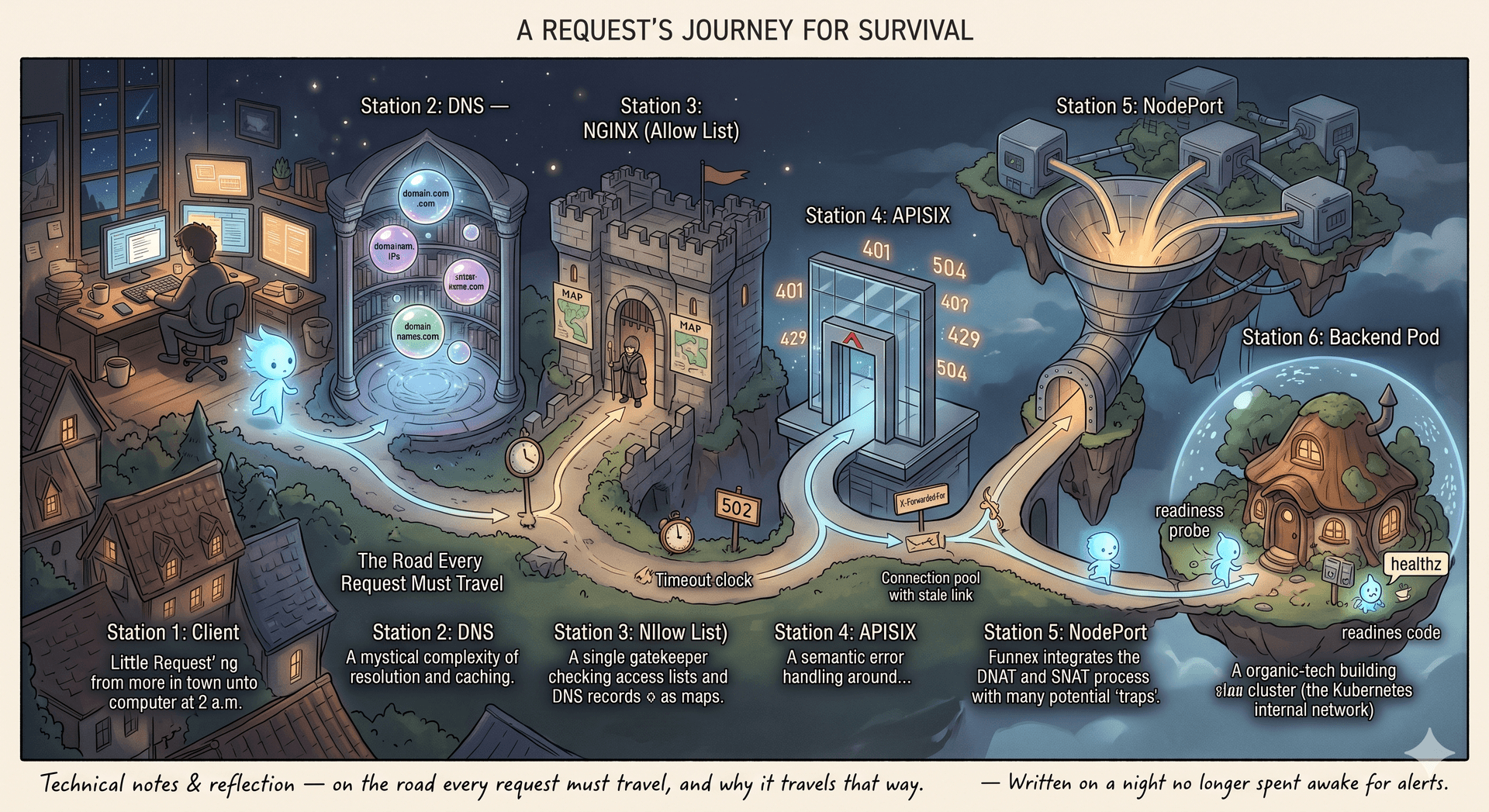
Six Stations, Six Ways to Die: A Request's Journey for Survival
Technical notes & reflection — on the road every request must travel, and why it travels that way.

I Built a DNS Server to Understand the Thing I'd Blindly Trusted for Ten Years
There are technologies you use every single day without ever looking them in the eye. For me, DNS was one of them. I'd been typing domain names for a decade. Buying domains, pointing records, waiting for "propagation," cursing when it didn't come up, rejoicing when it did — without really understanding why it came up. DNS, to me, was like the light switch on the wall: flip it and the room lights up; if it breaks, call an electrician. Until one deploy night, the site went down. ping to the IP was fine. curl straight to the IP returned the page. Only the domain name sat there in silence. I stared at it and realized something a little humiliating: I didn't know where to even start fixing it, because I had never truly understood the thing that was broken. So I did what probably only an engineer would find reasonable: instead of skimming the docs, I sat down and wrote an entire DNS server in Rust. The project is called mini-dns. This post is what a black box told me once I finally opened it up.
Discussion
0 Comments
Be the first to start the discussion.