Eigendrum: Hear the Eigenmodes of Any Shape You Draw
Eigendrum is a web tool that solves the drumhead eigenvalue problem in your browser—draw a shape, hear its modes, and explore the math behind the sound.
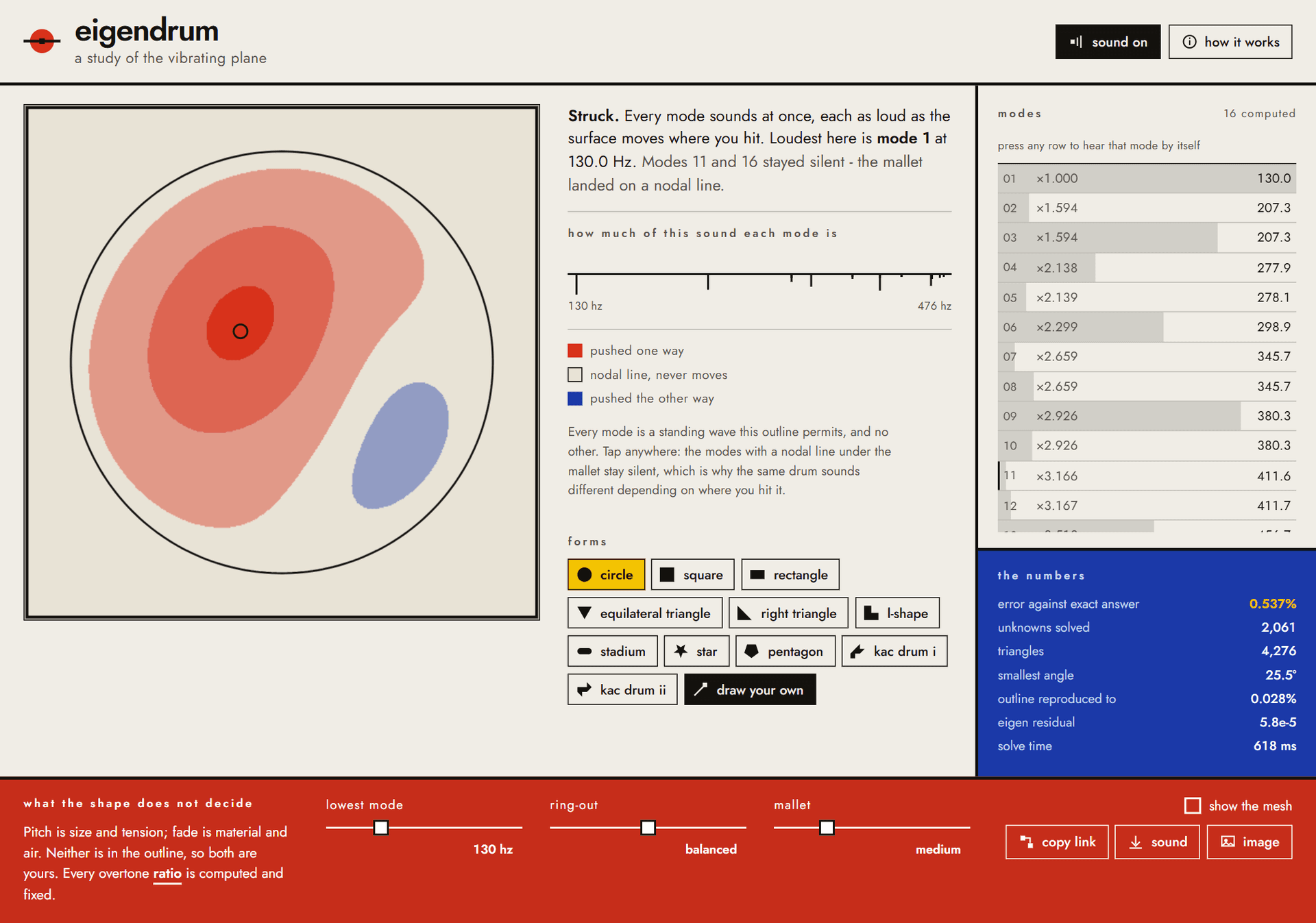
Eigendrum is a browser-based tool that turns any shape you draw—or write as a parametric equation—into a virtual drum. It numerically solves the eigenvalue problem for the drumhead's vibrations, letting you hear the fundamental and overtones of arbitrary geometries. The project is a working demonstration of finite element analysis, spectral theory, and the physics of percussion, all running client-side with no backend.
How It Works
The vibration of a clamped drumhead is governed by the Helmholtz equation with Dirichlet boundary conditions: −∇²u = λu inside the shape, u = 0 on the edge. Each solution u is a mode (a standing wave), and each eigenvalue λ corresponds to a frequency proportional to √λ. For almost every shape, this problem has no closed-form solution, so Eigendrum discretizes the shape into a triangular mesh, builds the finite element stiffness and mass matrices, and solves the generalized eigenvalue problem Kφ = λMφ to find the lowest modes.
Verification Against Known Spectra
The solver is tested on every change against shapes with exact spectra: a circle's frequencies are zeros of Bessel functions, and a rectangle's are π²(m²/a² + n²/b²). The numerical results match these to better than a tenth of a percent. Because the finite element method minimizes energy over a restricted space, the computed eigenvalues are guaranteed to be slight overestimates—never under—which provides a useful error bound.
Strike Position Matters
When you strike a point on the drum, each mode is excited in proportion to its amplitude at that point. Hit a node line (where a mode has zero displacement) and that mode is not excited at all. This behavior emerges naturally from projecting the mallet's impulse onto the mode shapes—it wasn't programmed as a special rule. The interface shows which modes your strike can and cannot reach, and lets you play individual modes in isolation, something no physical mallet can do.
Drums from Equations
Beyond freehand drawing, Eigendrum accepts parametric equations for the boundary. For example, r(t) = 1 + 0.3cos(5t) traces a five-lobed flower, and parametric x(t), y(t) pairs can reach shapes like nephroids or eggs that polar coordinates cannot. This makes shapes reproducible as text—the URL encodes the formula, so you can share and edit it directly in the address bar. Shapes that are too thin to mesh reliably are refused rather than returning misleading results.
Can One Hear the Shape of a Drum?
Mark Kac posed this famous question in 1966. In 1992, Carolyn Gordon, David Webb, and Scott Wolpert answered "no" by constructing two different shapes with identical spectra. Eigendrum includes these as "Kac drum I" and "Kac drum II"—both built from the same seven triangles rearranged, with the same area, perimeter, and every frequency matching. You can switch between them and hear that they sound identical despite looking different.
Modelling Choices
The frequency ratios, mode shapes, and fundamental pitch are determined entirely by the outline—that's physics. What the outline doesn't fix is wave speed (tension and density), so Eigendrum lets you set a reference pitch for a circle of the same area; each shape then lands above that by its own offset. All shapes are scaled to the same area before solving, so the offset is shape-dependent, not size-dependent. The mallet is modeled with adjustable width and a fixed contact time, and damping is Rayleigh damping, so higher overtones decay faster—which is why a drum darkens as it rings.
Implementation and Hosting
Eigendrum has no build step and no application backend—the mesh generation, eigenvalue solve, and audio synthesis all run in your browser. The shape lives in the URL fragment after the #, which browsers never send to a server, and analytics is configured not to record it. The site is hosted at eigendrum.com, with the GitHub repository providing the source code, including the solver and its tests.
The frequency ratios, the mode shapes and the pitch of the fundamental are physics, fixed entirely by the outline.
Source: Eigendrum
Discussion
0 Comments
Be the first to start the discussion.