SiFive's BigSky SF-2U870: A Boring RISC-V Server That Just Works
SiFive's new BigSky SF-2U870 development server brings RVA23 support to the RISC-V ecosystem, offering a boring, functional platform for developers—a sign the ecosystem is maturing.
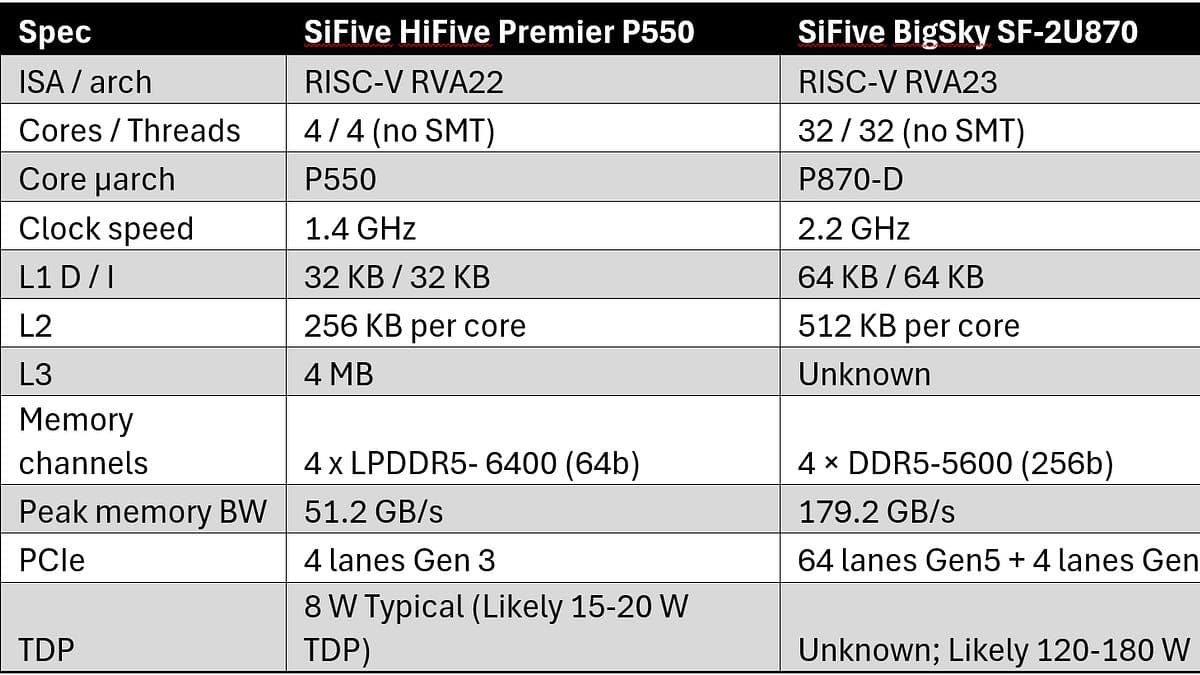
SiFive, one of the original RISC-V pioneers, has unveiled its first server platform: the BigSky SF-2U870. It's a standard 2U rackmount box packing 32 P870-D cores at 2.2 GHz, 256 GB of DDR5-5600, 64 lanes of PCIe 5.0 (plus 4 lanes of Gen 3), support for double-wide GPUs up to 450W, a 10/25 GbE OCP 3.0 NIC, and a mix of SATA and NVMe storage. The spec sheet is intentionally unremarkable—and that's the point.
Compared to SiFive's earlier HiFive Premier P550 development board, the BigSky is a massive step up. But the real headline isn't the core count or the memory bandwidth; it's RVA23 support. RVA23 is the RISC-V application profile that enables running Ubuntu 26.04 out of the box, without chasing firmware or patching kernels. That's a big deal for a developer platform—it means you can spend your time writing code instead of debugging bring-up.
When you pit the BigSky's SoC against current x86 parts, it doesn't win on raw specs. The Intel Xeon 6532P-B matches it on cores and clock, but offers SMT2, a 3.9 GHz boost, and a wider core. The AMD EPYC 8325P outclasses it in most respects. The most interesting comparison is against the Ampere Altra Q32-17, which served a similar development role—but the BigSky counters with higher clocks, a wider core, and PCIe Gen 5, while Altra counters with more lanes, more memory bandwidth, and lower TDP. And the Altra Q32-17 is the low-end SKU; the Q80-33 with 80 cores at 3.3 GHz would beat the BigSky outright.
But SiFive isn't trying to beat x86 or Arm. The BigSky is a development platform, and for that job it's fit for purpose—not because of the PCIe lanes, but because it supports RVA23. The RISC-V ecosystem has been held back by a lack of RVA23 silicon and boring platforms that can run CI without fuss. BigSky fills that gap.
There are some inconsistencies in SiFive's own marketing—clock speeds listed as both 2.0 GHz and 2.2 GHz, storage configs that don't match—but those are minor quibbles. What matters is that SiFive is shipping a server that just works, and that's a milestone for RISC-V.
The BigSky is boring, and that is a good thing. Boring platforms are the ideal state for a platform because it means that you can just start developing for the platform instead of messing around trying to get the system up and running.
| Spec | SiFive BigSky SF-2U870 | Intel Xeon 6532P-B | AMD EPYC 8325P | Ampere Altra Q32-17 |
|---|---|---|---|---|
| Cores | 32 (P870-D) | 32 | 32 | 32 |
| Base Clock | 2.2 GHz | 2.2 GHz | 2.2 GHz | 2.6 GHz |
| Boost Clock | N/A | 3.9 GHz | 3.7 GHz | N/A |
| Memory | 256 GB DDR5-5600 | DDR5 | DDR5 | DDR4-3200 |
| PCIe | 64x Gen5 + 4x Gen3 | Fewer lanes | Fewer lanes | 128x Gen4 |
| TDP | Not disclosed | Higher | Higher | Lower (150W) |
| RVA23 | Yes | N/A | N/A | No |
Discussion
0 Comments
Be the first to start the discussion.