Teardown: That Cheap 7-Port USB 3.0 Hub Is Actually USB 2.0 — and Dangerous
A teardown of a $5 AliExpress hub reveals six ports are wired as USB 2.0 with an STT chip, plus a backfeeding power jack that can damage your host PC.
If you’ve been tempted by a $5 “7-port USB 3.0 hub” on AliExpress, Gough Lui’s latest teardown is a cold shower. The hub arrived with a captive USB-A cable, seven blue ports, individual switches, and a barrel jack for external power. No markings, no brand, no power supply included. The price alone should have been a red flag.
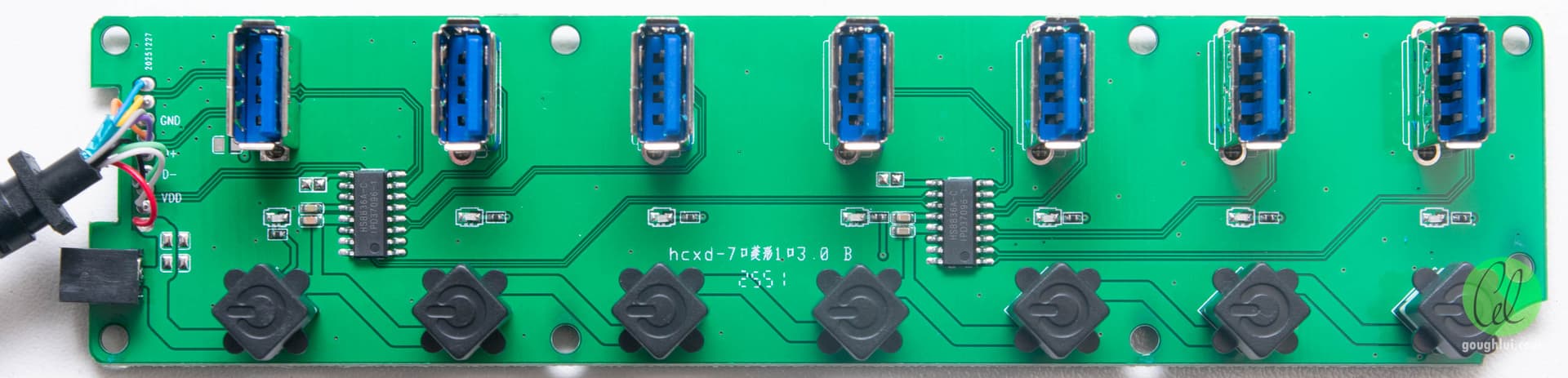
Inside, the deception is immediate. Six of the seven ports have only four pins — USB 2.0 at best. Only the top port carries the full USB 3.0 signal. The hub is essentially a USB 3.0 extension cable with a USB 2.0 hub tacked onto the D+/D- lines. The ports are blue to fake the USB 3.0 look, but the hardware tells the truth.
The hub uses two HS8836A chips, which are four-port USB 2.0 hubs with a single transaction translator (STT). That means all ports on each chip share the same USB 1.1 bandwidth — a known bottleneck when connecting multiple low-speed devices. No per-port power monitoring, no overcurrent protection.
Worse: the barrel jack’s internal switch is not used. The external power input is simply commoned with the VBUS line going back to the host. Plug in a power supply, and it backfeeds the computer. This is a design flaw that has been known to damage host ports for over two decades, yet it’s still being shipped.
Mechanical quality is equally poor. The USB 2.0 port shells have no solder at all on their ground pins — they rely entirely on friction. The USB 3.0 port has a single solder blob. Every insertion cycles the ports, flexing the board. Capacitors for local decoupling are omitted entirely.
Connected to a PC, the device enumerates as two stacked USB 2.0 hubs, not a USB 3.0 hub. The first port passes through USB 3.0 signals, but the rest are USB 2.0 only. The listing had 4.7 stars from 600+ reviews — most buyers probably never noticed.
This is a cautionary tale for engineers buying cheap hardware. The lesson: blue ports don’t mean USB 3.0, and a $5 hub is almost certainly cutting corners that can damage your equipment. If you need a real USB 3.0 hub, spend the money on a reputable brand.
Discussion
0 Comments
Be the first to start the discussion.