The Amiga 1000 at 40: The Machine That Was Too Far Ahead
Commodore's Amiga 1000 launched 40 years ago with preemptive multitasking and custom graphics/sound hardware that the rest of the industry wouldn't match for a decade. A look at what made it special — and why it failed commercially.
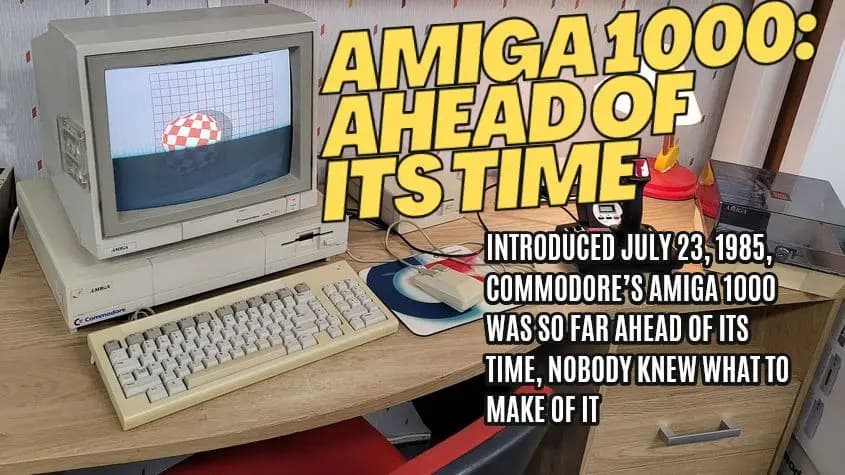
On July 23, 1985, Commodore released the Amiga 1000. It was a machine that, by any honest technical measure, was a decade ahead of its contemporaries. Its custom chipset delivered 4,096-color graphics, stereo sound, and a graphical user interface with full preemptive multitasking — all running on a 7.14 MHz Motorola 68000 with as little as 256 KB of RAM. The Macintosh had a GUI but no multitasking. The Atari ST had color but no preemptive scheduler. Windows 3.0's cooperative multitasking wouldn't arrive until 1990, and Windows 95's preemptive model came a full decade later.
What made it special
The Amiga's operating system, descended from the TRIPOS kernel developed at Cambridge University, supported true preemptive multitasking from day one. You could kick off a BBS download, switch to a word processor, and play a game — all simultaneously — on hardware that cost around $2,000 in 1985 (about $5,800 today). The only thing missing was memory protection, which would have required more expensive hardware. Windows NT had it, but NT didn't ship until 1993 and required a 386 with 12 MB of RAM.
The machine's custom chips — Agnus, Denise, and Paula — handled graphics, audio, and DMA separately from the CPU, giving it multimedia capabilities that PCs wouldn't match until the mid-1990s. Commodore even commissioned Andy Warhol to create digital art on the Amiga to demonstrate its prowess.
Why it failed
Commodore's management, particularly oligarch Irving Gould after founder Jack Tramiel left, treated the company as a cash cow rather than a technology leader. Marketing was anemic and confused. The most effective sales channel was word-of-mouth from passionate owners, but that couldn't sustain the platform. Commodore sold roughly 4.9 million Amigas total before going bankrupt in 1994 — a fraction of what the technology deserved.
The Amiga's instability reputation was largely self-inflicted by early software that didn't handle resource allocation gracefully, triggering the infamous "guru meditation" error. By 1991, the ecosystem had matured, but the damage was done. When the author bought a Windows PC in 1994, it felt like a downgrade — multitasking that worked "most of the time" but not reliably enough to trust.
The Amiga 1000 wasn't just a computer; it was a proof of concept for what personal computing could be. The industry caught up around 1995. That's a long time to wait.
The Amiga 1000 was 10 years ahead of its time. Its custom chipset had color graphics with up to 4,096 colors, stereo sound, a graphical user interface. Its operating system had full preemptive multitasking.
| Feature | Amiga 1000 (1985) | Macintosh (1984) | Atari ST (1985) | IBM PC/AT (1984) |
|---|---|---|---|---|
| CPU | Motorola 68000 @ 7.14 MHz | Motorola 68000 @ 8 MHz | Motorola 68000 @ 8 MHz | Intel 80286 @ 6-8 MHz |
| RAM | 256 KB – 1 MB | 128 KB – 512 KB | 512 KB – 1 MB | 256 KB – 512 KB |
| Graphics | 4096 colors, custom chipset | 512x342 monochrome | 640x400 16 colors | 640x350 16 colors (EGA) |
| Audio | 4-channel stereo (Paula chip) | Mono, 8-bit | 3-channel mono (YM2149) | PC speaker / optional Sound Blaster |
| Multitasking | Preemptive | None (cooperative via MultiFinder later) | None (GEM desktop) | None (DOS) |
| OS | AmigaOS (TRIPOS-derived) | System 1.0 | TOS (GEM-based) | MS-DOS 3.0 |
| Launch price | ~$1,295 (no monitor) | $2,495 | $799 (mono) / $999 (color) | ~$4,000 (typical config) |
Discussion
0 Comments
Be the first to start the discussion.