The Mathematical Blueprint Behind Gaudí's Sagrada Família
A deep dive into the modular arithmetic and polyhedral geometry that structures Antoni Gaudí's unfinished masterpiece.
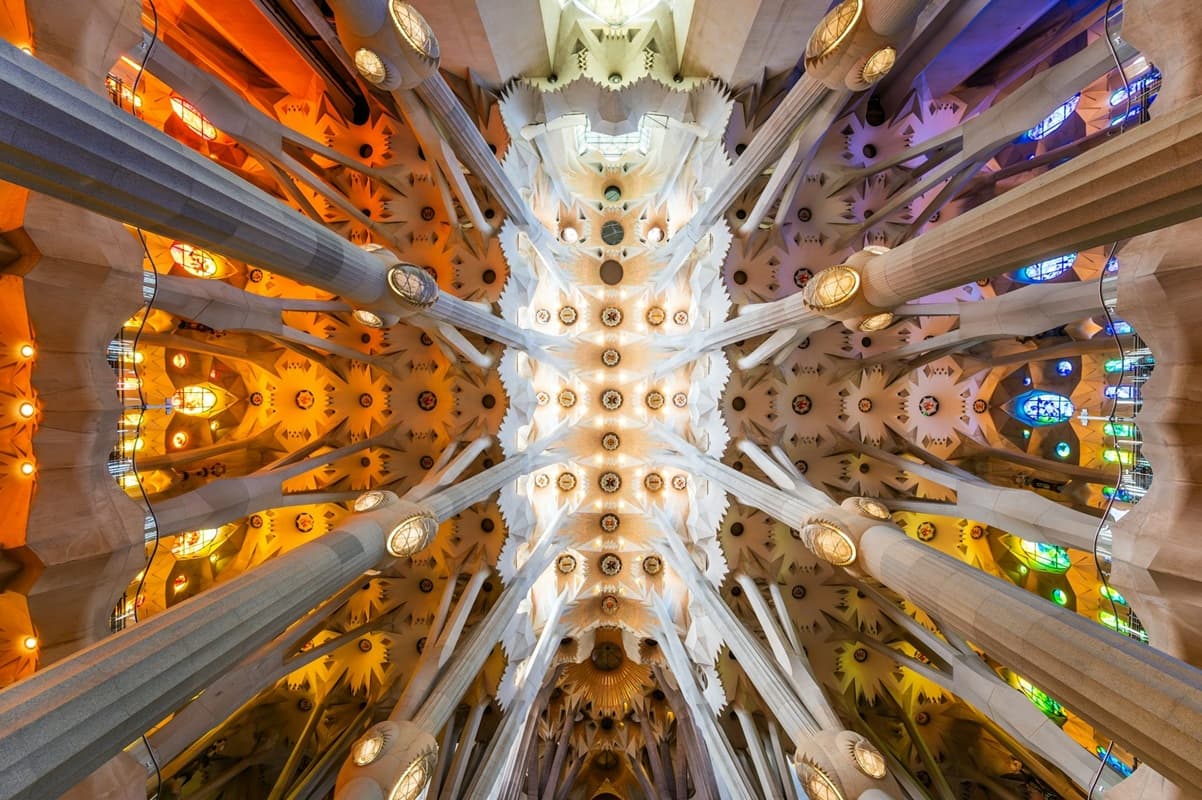
Antoni Gaudí's Sagrada Família isn't just a visual marvel—it's a monument built on a rigid mathematical framework. A recent analysis by researchers from the University of Barcelona reveals the proportional system and geometric principles that guided its construction, offering engineers and architects a case study in how mathematical elegance can underpin massive structural design.
The 12-Factor System
The number 12 dominates the basilica's dimensions. Gaudí, a deeply religious man, chose 12 for its biblical symbolism (12 apostles, 12 tribes of Israel), but also for its mathematical utility: 12 has divisors 1, 2, 3, 4, 6, and 12, which make it ideal for establishing clean proportions. According to mathematician Claudi Alsina i Català, the ratios between these divisors—1:4, 1:3, 1:2, 3:4, 2:3, and 1—form the backbone of the building's metric relationships.
The 7.5-Metre Module
Every major dimension of the temple is a multiple of 7.5 metres. The length is 90 m (7.5 × 12), the width 60 m (7.5 × 8), and the main nave width 45 m (7.5 × 6). Heights follow the same pattern: the apse vault reaches 75 m (7.5 × 10), the transept vault 60 m (7.5 × 8), the nave vault 45 m (7.5 × 6), the side aisle 30 m (7.5 × 4), and the choir 15 m (7.5 × 2). The central Tower of Jesus Christ tops out at 172.5 m (7.5 × 23), deliberately close to the height of Montjuïc hill. The four Evangelist Spires are 135 m (7.5 × 18).
Polyhedral Crowns and Catenary Arches
The towers are capped with regular polyhedrons: dodecahedrons on the Glory façade, truncated irregular octahedrons on the Nativity façade, and truncated cubes on the Passion façade. Above each polyhedron sits an icosahedron housing spotlights that illuminate the central cross. The 12-pointed star atop the Tower of the Virgin Mary is a regular dodecahedron with pyramidal pentagonal points—its diameter is exactly 7.5 m.
Inside, the structure relies on catenary arches and double-helix torsion columns that branch out like trees. These columns efficiently transfer loads without needing additional support. The skylights are one-sheet hyperboloids, made from straight lines for ease of construction while optimizing light capture.
Hidden Symbolism: 7 and 33
The canopy above the high altar forms a regular heptagon 5 m in diameter, representing the seven gifts of the Holy Spirit. On the Passion façade, a magic square—inspired by Albrecht Dürer's Melencolia I—has rows, columns, and diagonals that all sum to 33, Christ's age at his death.
For engineers and architects, the Sagrada Família demonstrates how a simple modular system combined with geometric rigor can produce both structural integrity and aesthetic harmony. It's a reminder that good design is often just applied mathematics.
Discussion
0 Comments
Be the first to start the discussion.