Vercel's AI SDK Factory: How 25-35% of Merged PRs Are Now Authored by Automation
Vercel built a 'software factory' to manage the AI SDK's exploding issue and PR backlog, with automation now authoring a quarter to a third of merged PRs and closing 70-80% of issues.
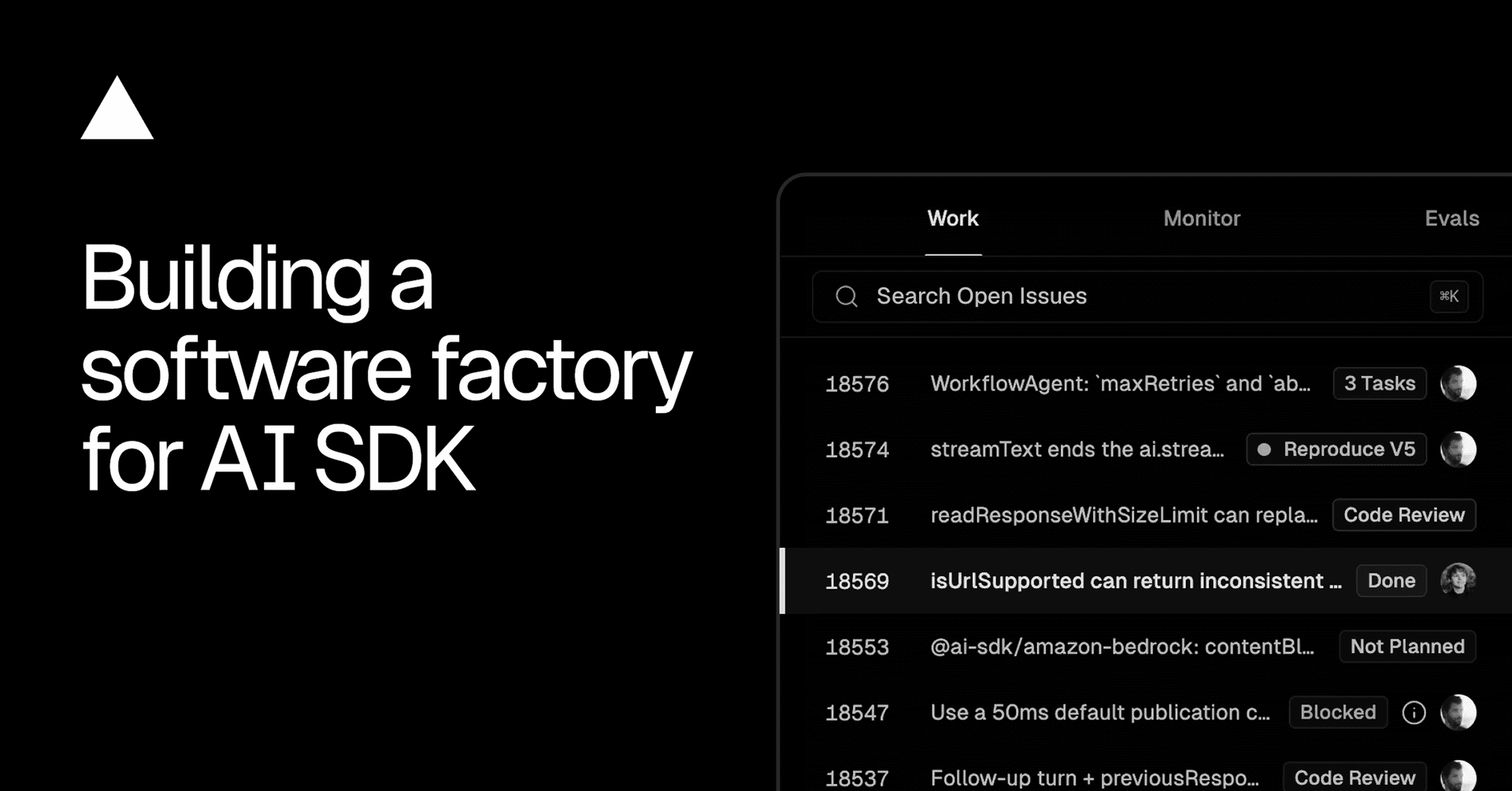
The AI SDK has become one of the most popular open-source AI projects, with over 20 million npm downloads weekly and 26,000+ GitHub stars. But popularity brought a crisis: the repo was receiving 100+ new issues monthly, and the release of Anthropic's Opus 4.6 model triggered a PR inflection point. By late June, the backlog had compounded to over 1,000 open issues and nearly 800 pull requests.
Maintaining the codebase means tracking four moving targets simultaneously: model providers (new providers, capabilities, bugs), UI frameworks (React, Next.js, Svelte, Vue, and others), sandboxes (execution environments for agents), and harnesses (adapters for Codex, Claude Code, Pi, and others).
Vercel's team realized this backlog wasn't a discipline problem—no human maintainer could close that gap by working harder, and with code generation being cheap, the backlog would only grow. So they built a 'software factory' instead of scaling themselves.
Four weeks in, the factory authors between 25% and 35% of merged PRs and closes 70-80% of issues. The factory UI gives reviewers a global view of the pipeline, allowing them to triage and approve work at scale.
Before building, the team asked three key questions: why existing agent-based approaches weren't enough, what type of factory to build, and how to ensure quality. The answers shaped a system that combines automation with human oversight, keeping the maintainers in control while letting the factory handle the volume.
That backlog is not a discipline problem. No maintainer, however good, can close that gap by working harder, and because generating code is cheap, it will only grow.
Source: Vercel
Discussion
0 Comments
Be the first to start the discussion.