Your Network Beats Your Grind: The Data on Weak Ties
Chetty's 21-billion-friendship study shows economic connectedness predicts upward mobility better than school quality or poverty rates. Weak ties, not close friends, drive job mobility. Engineers should treat their network as a lever, not a side quest.
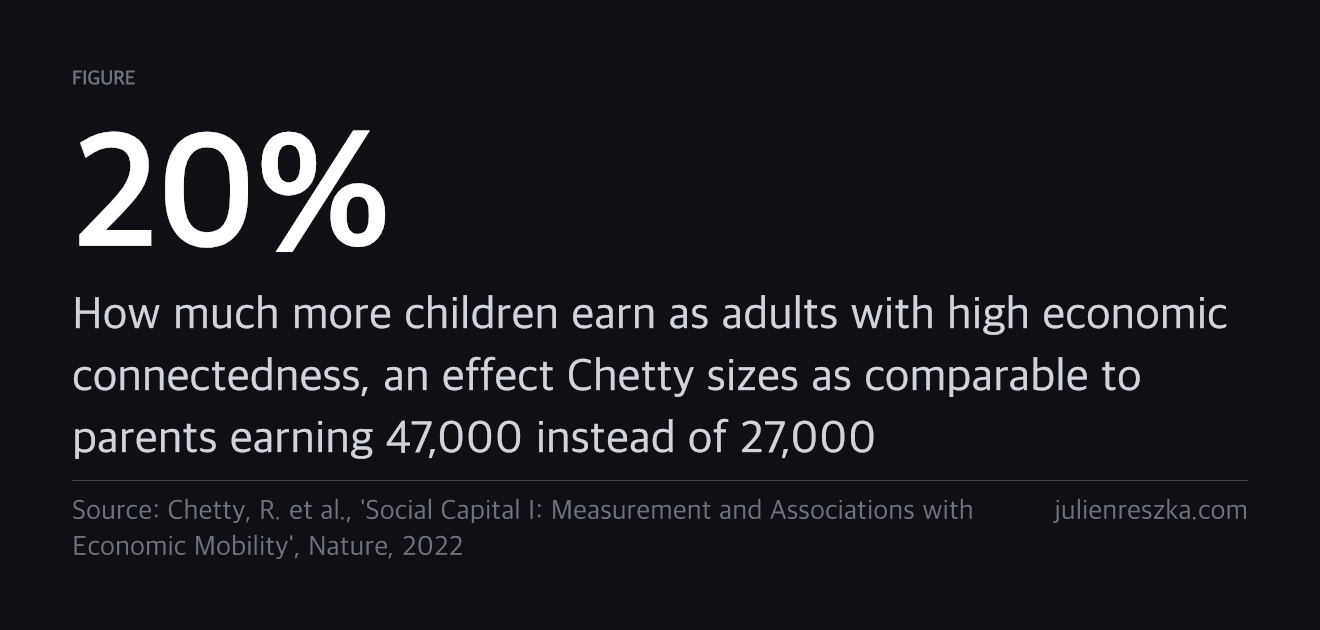
Every engineer knows the grind: more hours, more side projects, more LeetCode. But the best evidence on economic mobility says the deciding factor isn't how hard you work or how lucky you get—it's who you know. Raj Chetty and colleagues analyzed 21 billion Facebook friendships from 72 million Americans and found that children with high economic connectedness—friends who earn more than they do—earn 20 percent more as adults, an effect comparable to parents earning $47,000 instead of $27,000. It was the strongest predictor of upward mobility, beating school quality, segregation, and poverty rates.
The pattern is stark: fewer than 2 percent of low-income people's friends are in the top 10 percent of earners, while 34 percent of top earners' friends come from that same top decile. And the social capital most people try to build—volunteering, cohesive networks—showed no meaningful link to mobility. What matters is economic connectedness, not social cohesion.
The same logic applies to job hunting. A 1973 survey found 56 percent of men got jobs through contacts they saw only occasionally, not close friends. A 2022 randomized experiment on 20 million LinkedIn users confirmed causality: moderately weak ties created more job mobility than strong ones. The algorithm pulling those ties is a lever you can pull yourself.
Hard work and luck are real, but neither is reliably controllable. Your weak-tie network is. Most people spend a decade optimizing their grind and never an afternoon on their network. The data says that's backwards.
The people who move your career and your income are usually not your closest contacts or your longest hours. Build the layer of people you know a little, on purpose.
Discussion
0 Comments
Be the first to start the discussion.