Where Does Real Knowledge Come From in the Age of AI?

Introduction: When Looking Things Up Became Too Easy
We live in a strange era: it has never been easier to "know" something. Type a question, and AI answers in seconds coherent, confident, well-structured. Things that used to take an afternoon of digging through documents are now a single prompt away.
I use AI every day. To me, it's a remarkable tool: a vast knowledge base, a place to look things up, research, and brainstorm. But the more I use it, the more I notice a paradox: precisely because AI answers so smoothly, the human ability to learn and verify independently has become more important than ever.
This post is my attempt to think through that paradox and to draw a detailed map of the knowledge sources I believe each of us should deliberately build for ourselves.
Problem One: AI's Confidence Is Not the Same as Truth
Language models have a dangerous trait: they answer everything in the same confident tone, whether the answer is right or wrong. "Hallucination" when AI fabricates plausible-sounding information is not a rare bug. It's inherent to how these models work: they predict the most plausible next word, not the most true one.
This creates a cognitive trap. When we read an answer that is fluent, well-structured, and illustrated with examples, our brains automatically assign it high credibility even though we have no way to verify it on the spot. Ask AI about a field you know well, and you'll occasionally catch mistakes. The frightening question is: in the fields you don't know well, how many mistakes have slipped past you unnoticed?
The only person who can catch AI's errors is someone who already has a foundation in that domain. In other words: AI amplifies the knowledge of those who have it and amplifies the confusion of those who don't.
Problem Two: Who Is Steering?
There's a deeper layer to this. Every AI model is trained, fine-tuned, and shaped by a specific company with the data they chose, the values they instilled, and the boundaries they set. That isn't necessarily bad (I'd argue many of those boundaries are necessary), but it means one thing: an AI's answer is not "neutral truth." It is truth that has passed through a filter we cannot see.
In the newspaper era, at least we knew which way a given paper leaned. With AI, the filter is invisible. If an entire generation forms its worldview primarily through conversations with a handful of AI models from a handful of companies, then society's capacity for independent thought depends on whether those companies stay honest. That's far too large a bet to place with your own mind as the stake.
I'm not calling for a boycott of AI that would be both unrealistic and wasteful. What I'm saying is this: use AI the way you'd use a brilliant advisor who can be wrong and can be biased which means always keeping the final judgment for yourself. And to judge, you need capital of your own.
To Think Well, You Need Something to Think With
Critical thinking is not a standalone "skill." You cannot critically evaluate something you know nothing about. Criticism is, at its core, cross-referencing placing new information next to what you already know and have experienced, then looking for what fits and what doesn't. Someone with deep knowledge and experience has many anchor points to compare against; someone with none can only believe or disbelieve on gut feeling.
So the real question of the AI era is not "how do I learn to use AI?" but rather: "how do I build a foundation of knowledge and experience thick enough that no information source including AI can lead me around by the nose?"
Here is the map of sources I use, with an analysis of each one's strengths, weaknesses, and how to use it well.
A Map of Knowledge Sources
1. Books Foundation and Depth
Books remain the source with the highest "density of thought." A good book is the product of years of research, structured into a system, refined by editors and reviewers. When you read a book, you don't just receive information you follow the author's reasoning from the foundations up, something that fragmented AI answers and short articles can never give you.
Strengths: depth, systematic structure, relatively high reliability, and it trains sustained focus. Weaknesses: slow to update; plenty of bad books exist, so selection matters. How to use: prioritize foundational and classic works in your field the knowledge that ages slowly. Leave the fast-changing material to other sources.
2. Primary Sources and Original Documents Going to the Root
For technical people, this means official documentation, source code, RFCs, changelogs. In other fields, it means the original legal text, the original financial report, the original research paper, the original statistics. The general principle: every time information passes through someone's retelling, it gets distorted one more time. Reading primary sources strips away every intermediate layer of distortion including the AI layer.
Strengths: the highest accuracy available. Weaknesses: dry, and sometimes hard for beginners to parse. How to use: let AI summarize and guide you into the original documents but for any important decision, open the primary source and verify.
3. Research Papers and Professional Journalism Verified Updates
This is the middle layer: fresher than books, more trustworthy than social media. Peer-reviewed research, professional journals, engineering blogs from leading companies all have some quality-control mechanism built in.
Strengths: current and vetted. Weaknesses: quality varies enormously; clickbait and low-quality "studies" increasingly blend in — and now there's mass-produced AI-written content on top. How to use: build your own curated list of trusted sources rather than drifting with recommendation algorithms. Ask three questions before believing anything: Who wrote this? What do they gain if I believe it? Where does the data come from?
4. Courses, Videos, and Podcasts Structured Paths and Learning Everywhere
A good course gives you what self-study rarely can: a designed curriculum, exercises, feedback. Podcasts and videos are a great way to "learn passively" while commuting, cooking, or exercising listening to practitioners talk among themselves sometimes teaches you more than a textbook.
Strengths: accessible, uses otherwise dead time, provides a path. Weaknesses: wildly inconsistent quality; the feeling of "having learned" from watching a video is deceptive understanding a video is not the same as being able to do the thing. How to use: choose teachers as carefully as you'd choose books; and always pair it with immediate practice, or the knowledge evaporates within days.
5. People and Communities The Experience Books Don't Contain
Mentors, skilled colleagues, professional communities this is "living" knowledge. They give you what no document records: hard-won lessons, real-world context, the traps that only someone who has fallen into them can warn you about. One question to the right person can save you weeks of fumbling.
Strengths: battle-tested experience, two-way feedback, real-time updates. Weaknesses: personal experience can be one-sided; communities have their own herd thinking too. How to use: don't just ask — contribute back. The people who give the most to a community always end up learning the most. And when you hear someone's experience, ask about their context: what worked for them may not fit your situation.
6. Practice and Experience Where Knowledge Becomes Yours
This is the most important source of all, and the one thing AI absolutely cannot do for you. Reading ten articles about swimming doesn't teach you to swim. Knowledge only truly belongs to you once it has passed through your hands: writing your first line of code and watching it fail, shipping your first project and watching it break, applying a theory and discovering reality is messier than the book said.
Failure in practice is the most powerful verification mechanism there is: it shows you exactly where you thought you understood but didn't. No other source gives feedback that honest.
Strengths: the deepest-rooted knowledge, the most precise detection of gaps in your understanding. Weaknesses: slow, effortful, sometimes costly. How to use: for everything you learn, ask "can I build something small with this today?" Small projects, written notes, teaching it to someone else teaching is the harshest exam of understanding there is.
The Power Is in the Intersection
What matters most is not any single source, but the cross-referencing between them. When you read something in a book, hear a practitioner confirm it, and then do it yourself and see it hold up (or fall apart!) that knowledge becomes solid in a way no single source can achieve.
And this is exactly where AI belongs in the system: one source among many the fastest and most convenient, but never the only one. Use AI to open doors, summarize, and suggest directions; then verify with primary sources, with real people, with your own hands.
Conclusion: Learn for Real, to Keep the Right to Think for Yourself
AI will keep getting better. Its answers will keep getting smoother and harder to fault. In that world, a person's value no longer lies in access to information everyone has access but in the ability to appraise it: knowing what to trust, what to verify, and when you're being steered.
That ability doesn't appear on its own. It's built brick by brick: every book read carefully, every primary source you took the trouble to open, every conversation with someone better than you, every project built and fixed with your own hands.
The smarter AI gets, the more humans need to truly learn. Not to race the machine that race is meaningless but to hold on to the most precious thing we have: the right to think and decide with our own minds.
What about you which sources are you building your knowledge from? I'd love to hear your perspective.
Related reading
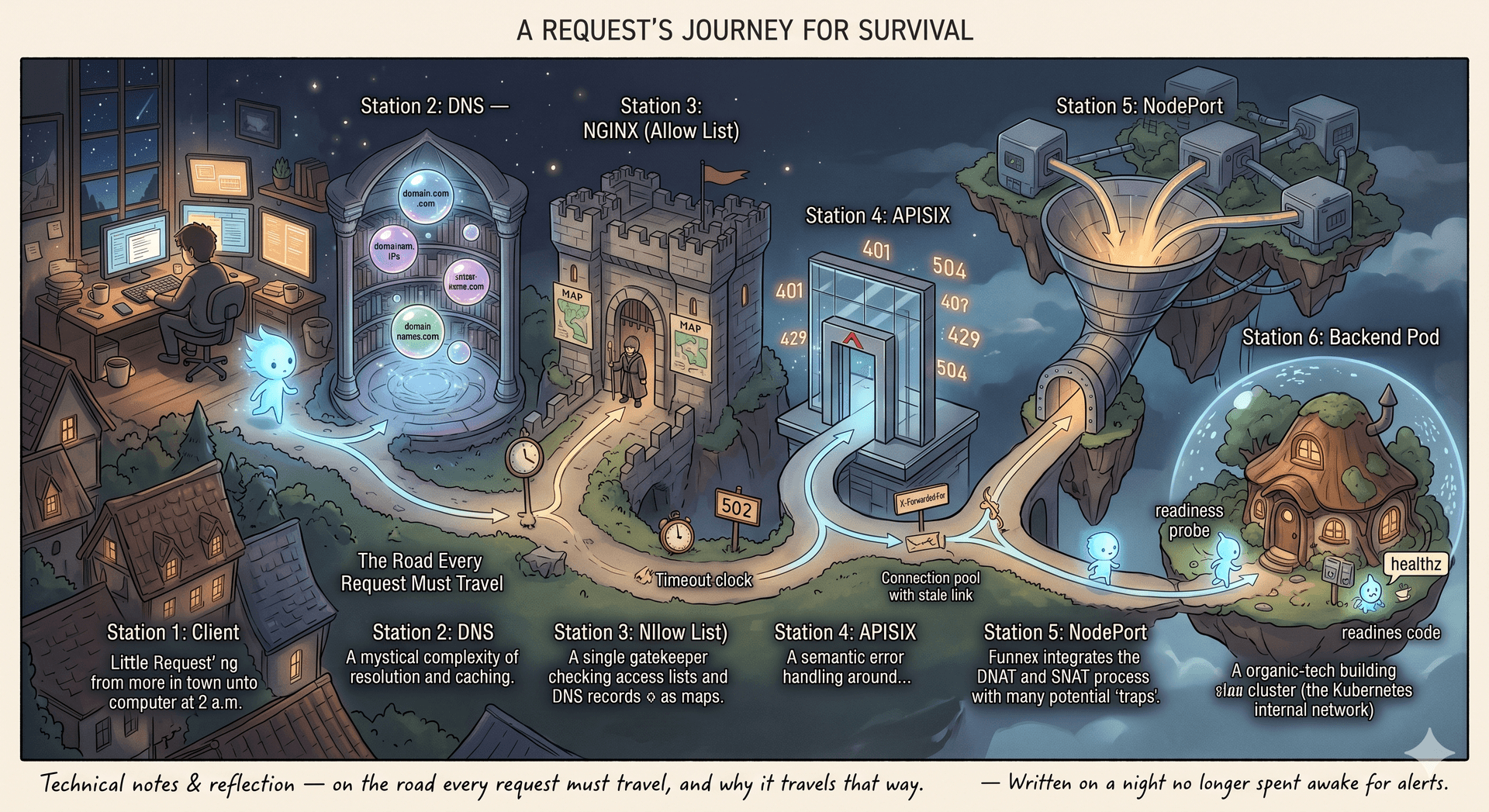
Six Stations, Six Ways to Die: A Request's Journey for Survival
Technical notes & reflection — on the road every request must travel, and why it travels that way.
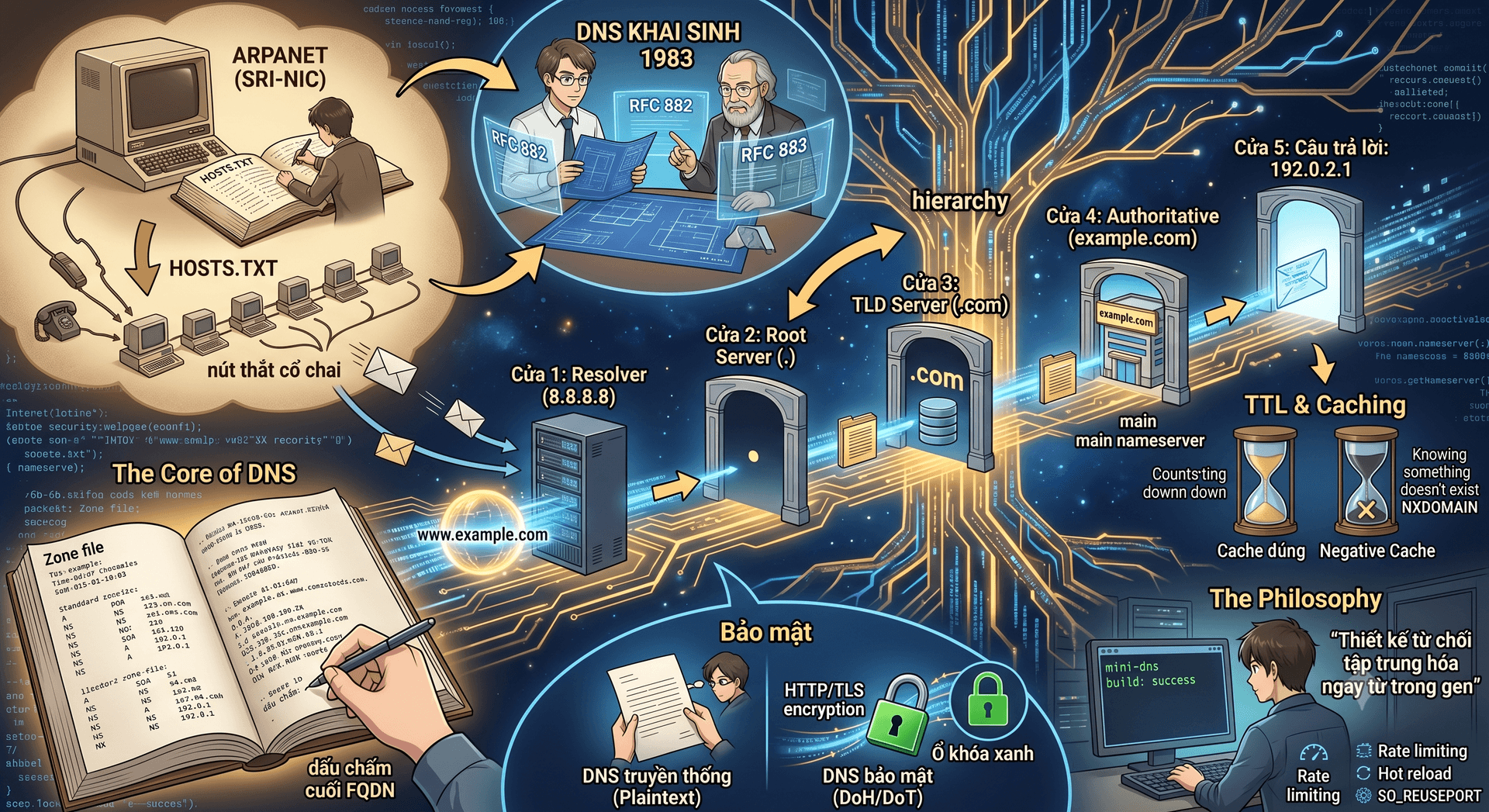
I Built a DNS Server to Understand the Thing I'd Blindly Trusted for Ten Years
There are technologies you use every single day without ever looking them in the eye. For me, DNS was one of them. I'd been typing domain names for a decade. Buying domains, pointing records, waiting for "propagation," cursing when it didn't come up, rejoicing when it did — without really understanding why it came up. DNS, to me, was like the light switch on the wall: flip it and the room lights up; if it breaks, call an electrician. Until one deploy night, the site went down. ping to the IP was fine. curl straight to the IP returned the page. Only the domain name sat there in silence. I stared at it and realized something a little humiliating: I didn't know where to even start fixing it, because I had never truly understood the thing that was broken. So I did what probably only an engineer would find reasonable: instead of skimming the docs, I sat down and wrote an entire DNS server in Rust. The project is called mini-dns. This post is what a black box told me once I finally opened it up.
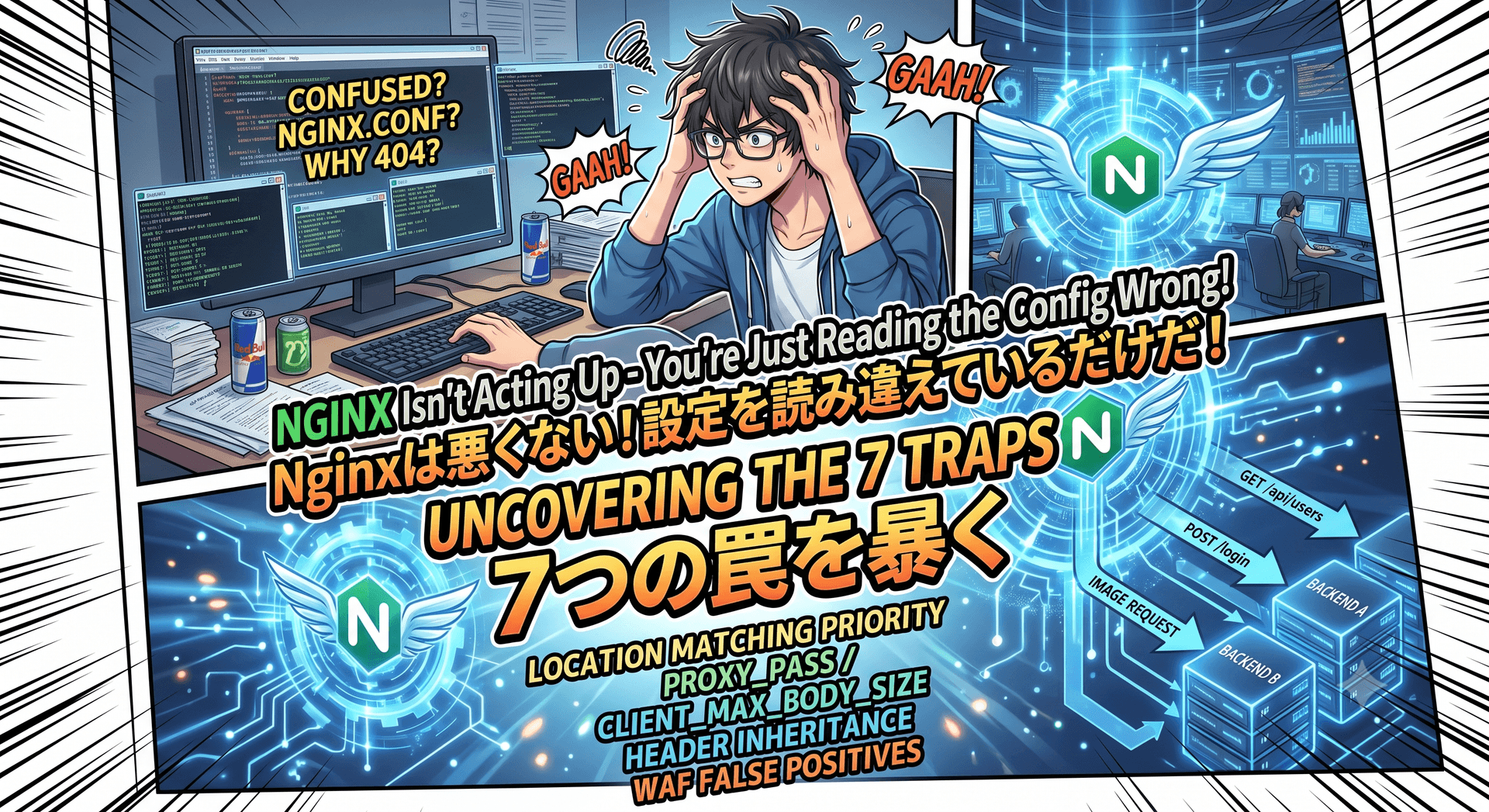
Nginx Isn't Acting Up — You're Just Reading the Config Wrong
There's a funny paradox among developers: we'll happily argue for a week about whether the backend should be written in Rust, Go, or Node.js — but when it's time to ship to production, 90% of us quietly type apt install nginx and stick it out front. Nginx is everyone's go-to gatekeeper — and also the thing that has people debugging until 2 a.m., still unable to figure out why one simple request keeps returning a 404. Here's the interesting part: the bug is almost never in Nginx. It's that we read the config file like a script that runs top to bottom — when that's not how Nginx works at all. This isn't a listicle of "common Nginx errors" for you to copy-paste onto your server. The goal is to hand you a mental model: to understand how Nginx thinks, so the seemingly magical traps below become predictable instead of leaving you staring blankly at the screen.
Discussion
0 Comments
Be the first to start the discussion.