How Donkey Kong Toppled Atari: The Licensing Deal That Changed Gaming
The story of how Nintendo's Donkey Kong arcade hit led to Atari walking away from licensing the Famicom (NES), reshaping the console market.
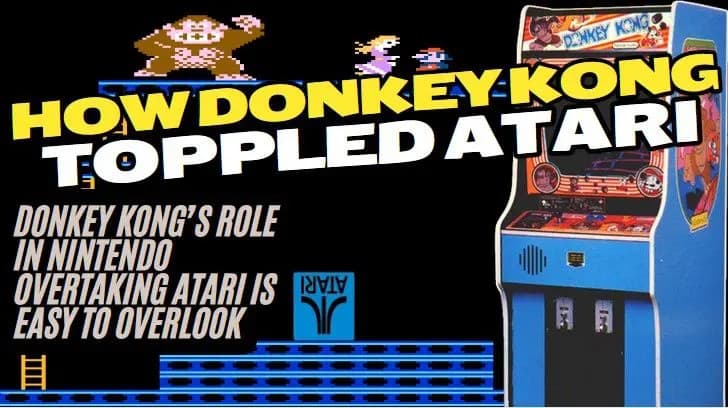
In July 1981, Nintendo released its third arcade game, Donkey Kong, which became a global phenomenon. But its impact went far beyond arcade dominance—it directly led to Atari losing its chance to distribute the Nintendo Entertainment System (NES) in North America, a decision that reshaped the home console market.
Nintendo's gamble
Nintendo had been in business for nearly a century making traditional games before entering electronics in the 1970s. Its first two arcade titles, Sheriff and Radar Scope, did well in Japan but left Nintendo with a surplus of cabinets after Radar Scope flopped internationally. The company needed a hit to clear that inventory.
Shigeru Miyamoto drew inspiration from King Kong, Popeye, and Beauty and the Beast to create Donkey Kong. Unable to license Popeye, he cast a deranged gorilla as the villain and a character named Jumpman (later Mario) as the hero. The game launched on July 9, 1981, and became the highest-grossing arcade game of 1981 and 1982.
Licensing chaos
Donkey Kong's success triggered a licensing war. Coleco secured rights for home consoles, including a famously poor Atari 2600 port, while Atari got home computer rights. At the June 1983 Consumer Electronics Show, Coleco demonstrated an enhanced Donkey Kong running on its Adam computer—a machine that was essentially a ColecoVision add-on. Atari CEO Ray Kassar saw this as a contract violation and was furious.
The Adam computer flopped, selling only about 100,000 units before being discontinued due to quality issues. But the damage was done.
The deal that wasn't
Nintendo was preparing to launch its next-generation console, the Famicom, in Japan and wanted a North American distributor. Atari was the obvious partner. Kassar had planned to sign the distribution deal at CES in June 1983 but delayed it over the Donkey Kong/Adam spat. On July 7, 1983, Atari's board forced Kassar out. His successor, James Morgan, never revisited the deal.
Atari walked away from distributing the NES over a dispute about a game running on a computer that sold a paltry 100,000 units. Nintendo eventually released the NES worldwide on its own, partnering with toy companies for distribution. The NES sold 60 million units that generation, while Atari's 7800 languished in third place behind Nintendo and Sega.
Legacy
Atari withdrew from the console market in 1993 after the Jaguar's failure. Nintendo, meanwhile, continued releasing consoles and remains a major player. The rest is history—but it almost wasn't. If Atari had secured the NES, the post-1983 crash recovery might have looked very different.
Discussion
0 Comments
Be the first to start the discussion.