Matrox: The Forgotten Pioneer of PC Graphics
From a Montreal basement to NASA's Viking mission, Matrox built the graphics cards that defined early computing. This is the story of a company that out-innovated its rivals—then got swallowed by the PC revolution.
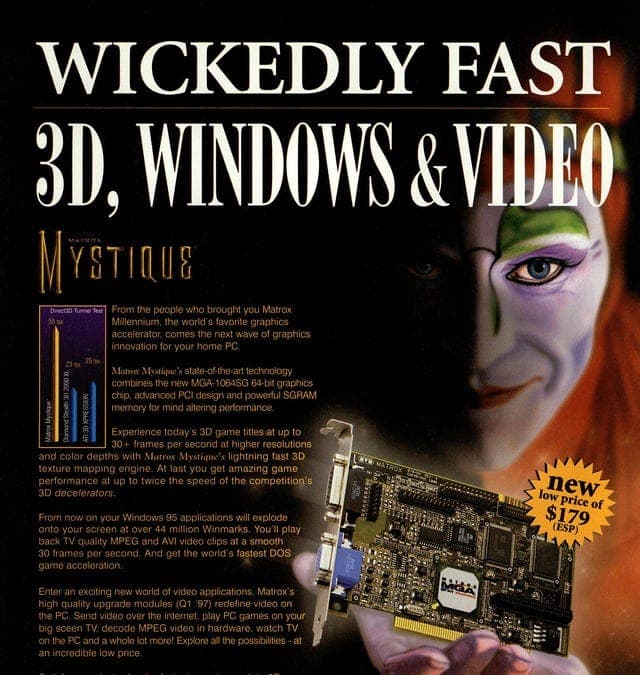
Before NVIDIA and AMD, before Voodoo and GeForce, there was Matrox. Founded in 1976 by Lorne Trottier and Branko Matić in Dorval, Quebec, the company made its name by building some of the first high-resolution graphics adapters for the nascent microcomputer market. Their story is a masterclass in early hardware entrepreneurship—and a cautionary tale about the brutal pace of platform shifts.
From Video RAM to S-100 Dominance
Matrox's first product, the MTX-1632, was a video RAM board that generated 32x16 ASCII display output. Priced at $198, it found immediate traction thanks to a free listing in Electronics magazine, netting $20,000 in orders. The follow-up, the MTX-256², offered 256x256 dot raster resolution with DMA—a feature that made it the best display adapter per dollar in 1976, undercutting DEC's $14,000 GT-40 by a factor of twenty.
The company's big break came at the Personal Computer Festival in Atlantic City in August 1976. Surrounded by S-100 bus machines like the Altair 8800, Trottier saw the future. The result was the ALT-256², an S-100 card that packed 65,536 x 1 bit of refresh memory, composite video output, and 256x256 resolution into a single slot. It offered four times the resolution of competing adapters, plus color and gray scale support.
Scaling Up and Moving On
By 1978, Matrox boasted over 10,000 installations, including ground control displays for NASA's Viking mission. The company expanded into Wall Street in 1979 with the Quad Video board, which drove four displays from a single card. Trottier adopted HP-style management—profit sharing, daycare, and a relaxed atmosphere—and the company grew 200% per year, reaching 50 employees by 1979.
The early 1980s brought the GXT-1000 terminal and the GXB-1000 controller, which pushed resolution to 1000x1000. The budget SX-900, powered by an Intel 80286 and an NEC uPD7220, hit a 20 MPixels/sec fill rate at a $2,000 price point—impressive for 1985.
The IBM PC Tsunami
But the IBM PC and its clones were already reshaping the market. Matrox adapted its ALT-512 hardware to the ISA bus, producing the PIP-512 frame grabber and MIP-512 video adapter. The company survived, but the era of exotic, high-end graphics cards for hobbyists was ending. The PC platform standardized everything, and Matrox would spend the next decades fighting for scraps in a commodity market.
Matrox's early history is a reminder that innovation alone doesn't guarantee survival. The company that once powered NASA's displays had to pivot, again and again, just to stay relevant. Today, Matrox is a niche player in multi-display and video capture—a shadow of the pioneer that defined graphics for a generation.
Nothing else in the market offered a 'high resolution' display with DMA for under $1000.
| Product | Year | Resolution | Price (2026 USD) | Key Feature |
|---|---|---|---|---|
| Matrox MTX-1632 | 1976 | 32x16 text | $1,166 | Video RAM board |
| Matrox MTX-256² | 1976 | 256x256 | $3,710 | DMA, multiple video modes |
| Matrox ALT-256² | 1978 | 256x256 | ~$1,000 | S-100 bus, refresh memory |
| DEC GT-40 | 1976 | 1024x768 | ~$82,000 | Hardware vector graphics, PDP-11 |
| Matrox SX-900 | 1985 | 640x480 | ~$5,500 | 20 MPixels/sec fill rate |
Discussion
0 Comments
Be the first to start the discussion.